

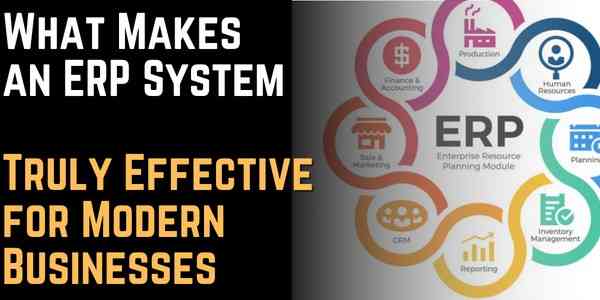
What Makes an ERP System Truly Effective for Modern Businesses
As businesses evolve and expand, the need for efficient and integrated systems becomes more critical. Modern companies in Saudi Arabia are increasingly adopting integrated ERP solutions for business operations to streamline their processes and stay competitive in a rapidly changing market. ERP systems are not just tools for managing finances or tracking inventory; they are comprehensive platforms that connect every aspect of a business, from HR and sales to customer management and production.

Recent studies show that 74% of organizations that invest in ERP systems report a positive return on investment (ROI) within just two years.
In this blog, we’ll dive into the key characteristics of an effective ERP system and how integrated ERP solutions can optimize your business operations, improve decision-making, and set the stage for sustained success.
What Are Integrated ERP Solutions?
Integrated ERP solutions for business operations combine all of a company’s key functions into a unified platform. These solutions help businesses manage core processes, from procurement and inventory management to accounting and customer relationship management. By consolidating data into one system, businesses eliminate the need for separate, disconnected systems that create silos of information.
In Saudi Arabia, businesses are increasingly recognizing the importance of ERP systems in addressing local regulatory requirements, such as VAT compliance, ZATCA e-invoicing, and labor law regulations. An integrated ERP system can seamlessly manage these requirements, ensuring businesses stay compliant while focusing on growth.
Why Are Integrated ERP Solutions Important?
Here are some of the key benefits of using integrated ERP solutions:
1. Streamlined Operations
By centralizing data and automating repetitive tasks, ERP systems reduce the manual effort involved in daily operations. With everything in one place, businesses can handle customer orders, track inventory, generate invoices, and manage payroll—all from a single platform. This reduces duplication of work, improves communication between departments, and increases efficiency.
2. Improved Decision-Making with Real-Time Data
In modern business environments, speed and accuracy in decision-making are critical. Integrated ERP systems provide real-time data that offers valuable insights into various aspects of business operations. This allows executives and managers to make data-driven decisions quickly, identify opportunities for growth, and address any potential challenges proactively.
For example, with up-to-date financial data at their fingertips, CFOs can track cash flow and profitability in real-time, enabling them to allocate resources more efficiently and make informed investment decisions.
3. Customization to Meet Business Needs
No two businesses are exactly alike. Modern ERP systems offer a level of customization that allows businesses to tailor the software to their specific industry and operational needs. Whether you’re in retail, manufacturing, healthcare, or another industry, you can configure your ERP system to accommodate unique workflows, reports, and integrations.
4. Scalability for Business Growth
As businesses grow, their needs evolve. An effective ERP system must be scalable to accommodate increasing demands. Whether it’s adding more users, expanding into new markets, or supporting additional functions, an ERP system should be able to grow with your business. With integrated ERP solutions for business operations, companies can scale their systems without worrying about disruptions or downtime.
5. Improved Compliance and Risk Management
For businesses operating in regions like Saudi Arabia, compliance with local laws and regulations is crucial. A good ERP system helps businesses adhere to financial and tax regulations, including VAT and e-invoicing requirements. The integration of compliance-related features into the ERP system ensures that businesses avoid penalties and maintain smooth operations.
For example, in Saudi Arabia, businesses must comply with regulations set by the ZATCA (Zakat, Tax, and Customs Authority). ERP systems designed for Saudi businesses will include features such as automatic tax calculation and invoicing that meet local standards.
What Makes an ERP System Truly Effective in 2026
When evaluating ERP systems, it’s crucial to look for features that maximize operational efficiency, adaptability, and growth potential. Below are the essential components that make ERP systems truly effective for modern businesses:
1. Cloud-Based Solutions with Mobile Accessibility
- Flexibility: Cloud-based ERP systems allow businesses to access data and software from anywhere, at any time, which is essential for remote and hybrid work environments.
- Cost savings: No need for expensive infrastructure or constant software updates.
- Mobile accessibility: Employees can manage tasks, track inventory, and approve expenses on the go, improving productivity and decision-making speed.
2. Integrated CRM and Real-Time Data Access
- CRM integration: Synchronized customer data across sales, marketing, and inventory functions leads to improved customer satisfaction and better sales forecasting.
- Real-time access: Provides the latest data instantly, allowing faster, more informed decisions.
- Example: A sales team can access real-time inventory levels to offer accurate information to customers.
3. Automation and Workflow Optimization
- Task automation: Routine tasks like order management, invoice processing, and payroll are automated, reducing human error and increasing productivity.
- Focus on strategy: Employees can concentrate on strategic activities instead of time-consuming tasks.
- Example: Automated triggers can reorder supplies when inventory levels fall below a set threshold, avoiding stockouts.
4. Advanced Reporting, Analytics, and Business Insights
- Customizable reports: ERP systems generate tailored reports to track KPIs, monitor performance, and make data-driven decisions.
- Data visualization: Dashboards and charts help businesses identify trends, forecast performance, and optimize strategies.
- Example: Business leaders can use real-time reports to respond promptly to issues and opportunities.
5. Customization and Scalability
- Customization: Tailor the ERP system to match unique workflows, compliance standards, and industry-specific needs.
- Scalability: ERP systems should be able to grow with the business, supporting new functions, users, and locations as the business expands.
- Example: A small business can start with basic accounting and inventory features and scale up to include HR, manufacturing, and CRM modules as it grows.
6. Seamless Integration Across Functions
- Eliminates silos: ERP integrates various functions like finance, HR, marketing, and inventory, providing one cohesive platform.
- Real-time data flow: Ensures that departments access the same up-to-date information, reducing inefficiencies.
- Enhanced communication: Improved collaboration and faster decision-making across departments.
The Future of ERP Systems
The future of ERP systems is poised to be shaped by continuous advancements in technology, especially in areas like AI, machine learning, and automation. As businesses become increasingly data-driven, ERP systems will evolve to offer even more powerful predictive analytics, enabling businesses to anticipate trends and make proactive decisions.
Key developments on the horizon include:
- AI-Driven Insights: ERP systems will integrate advanced AI capabilities, allowing for smarter decision-making, predictive forecasting, and automated decision support.
- Cloud & Edge Computing: As cloud technologies continue to improve, ERP systems will become even more flexible and accessible. Edge computing will enable faster data processing at the point of use, improving responsiveness.
- Increased Customization: Future ERP solutions will offer even more tailored experiences, adapting to the unique needs of businesses across different industries.
- Enhanced User Experience: With improvements in UX design, ERP systems will become even more intuitive and easier to use, reducing the learning curve for employees.
As the business landscape evolves, ERP systems will become even more integral in driving efficiency, agility, and long-term success for companies worldwide.
Conclusion
Effective ERP systems are crucial for modern businesses aiming to scale, streamline operations, and improve decision-making. The key to a truly effective ERP system lies in its ability to integrate different business functions, provide real-time data access, automate routine tasks, and be scalable and customizable.
Integrated ERP solutions for business operations provide businesses with the tools they need to stay competitive in today’s fast-paced market, especially in regions like Saudi Arabia, where digital transformation is rapidly reshaping industries.
As more businesses in Saudi Arabia and beyond turn to ERP solutions to optimize their operations, choosing the right system is more important than ever. HAL ERP, with its locally tailored solutions and advanced features, offers the perfect platform for businesses looking to succeed in the digital age.


About Author
