

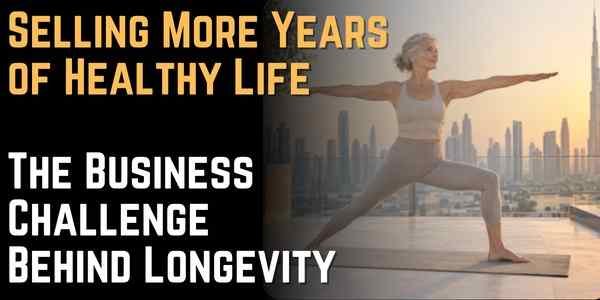
Selling More Years of Healthy Life: The Business Challenge Behind Longevity
For most of the twentieth century, medicine had one job.
Keep people alive longer.
It worked. A child born today in most developed countries can expect to live decades longer than their great-grandparents did.
But somewhere along the way, something strange happened.
We got much better at delaying death than we did at preserving the quality of the years before it.
People are living longer now. They are not, on the whole, living better for longer. That gap between lifespan and what researchers call healthspan has quietly become one of the trickiest business problems in modern wellness.
A Product That’s Hard to Define
Ask ten people what “healthy ageing” means to them and you’ll get ten different answers.
For a fifty year old executive, it might mean staying sharp enough to run a company for another decade. For a retiree, it might mean gardening without back pain. For a thirty five year old tracking every biomarker on a wearable, it’s something else entirely.
Compare that to a regular pharmaceutical. Success there is measured against a disease with a name and a clinical endpoint. Longevity has no clean finish line like that. It’s trying to sell an outcome that’s deeply personal and almost impossible to standardize.
That’s not a marketing problem you fix with better copywriting. It’s structural. And it explains why so many well funded wellness companies struggle to build anything that looks like a real business.
Why It’s Harder to Sell Health Than to Sell a Cure
Take a course of antibiotics. Within a few days you feel the difference.
Now take a longevity protocol. Better sleep. Resistance training a few times a week. A handful of supplements. Quarterly bloodwork. None of that produces an overnight result. The payoff, if there is one, shows up years later, quietly, in the form of problems that never happened.
Most people are simply not wired to pay a premium today for an absence of trouble a decade from now.
There’s also the trust problem. Because longevity results are so slow to show up, the space has attracted more than its fair share of unproven claims, from ice baths marketed as cure alls to supplements backed by nothing but a testimonial. Sophisticated, wealthy consumers, the exact people with the money to spend seriously on this category, tend to be the most skeptical of all. They’ve watched a parade of wellness fads come and go already. Earning their trust takes years of consistent delivery, not a clever launch campaign.
And the market itself refuses to sit still. Longevity spans nutrition, sleep science, hormone therapy, fitness, mental health, skincare, social connection. No single company can plausibly claim expertise across all of it. But a person experiences ageing as one continuous process, not eight separate product categories.
A brilliant sleep app still leaves you exposed if your diet is a mess. A great personal trainer can’t fix chronic loneliness. Any single point solution, however well designed, tends to feel incomplete.
Regulation adds one more layer of friction. Because longevity sits somewhere between wellness and medicine, most products get marketed under looser wellness rules rather than strict medical approval pathways. That keeps costs down. It also caps how boldly companies can talk about what their product actually does, which caps what they can charge for it.
What’s Actually Working
None of this means the category is unbuildable. A handful of models have proven they can survive all of the above. Here’s what they have in common.
Membership structures are one. Instead of selling a single transaction, they sell an ongoing relationship. Regular check ins. Adjustments over time. A reason to stay engaged month after month. That rhythm matches how healthspan actually improves, gradually, not in a single purchase.
Physical spaces matter more than most tech first founders expect. Private clubs, clinics and retreats that combine expert oversight with an in person experience can charge meaningfully more than a purely digital product. Sitting across from a real practitioner builds trust faster than any app ever could. Wealthy clients in particular will pay handsomely for privacy and a sense that this space was built specifically for them.
Data helps too, but only when it turns into something you can actually act on. Cheap biomarker testing is everywhere now. The companies pulling ahead are the ones turning raw numbers into a specific personal recommendation instead of a generic wellness newsletter.
And then there’s community, which turns out to matter almost as much as anything clinical. Loneliness is now recognized as a serious driver of poor health outcomes later in life. It hits successful, high net worth people harder than most assume. Plenty of professional contacts. Thin personal ones. Businesses that build a genuine sense of belonging, not just a customer list, tend to keep members far longer than those selling isolated products.
The Real Challenge
Strip away the marketing and the core problem is this.
Longevity businesses are trying to sell something people want badly but can’t easily verify. Something deeply personal that resists standardization. Something valuable over decades but awkward to price today.
The companies making real progress aren’t chasing a single miracle product. They’re building integrated experiences, part medical rigor, part lifestyle design, part genuine community, that actually reflect how ageing works in practice.
The demographic tailwind is real. A growing, affluent, health conscious population is entering mid life with more money and more years ahead of them than any generation before. Capturing that opportunity won’t come down to one breakthrough launch. It will come down to which businesses have the patience to earn trust slowly and build something that compounds, much like healthy ageing itself.
Elizabeth Keshchian is Director of International Business Development, currently involved in building an integrated longevity focused lifestyle community from the ground up. Her perspective here comes from first hand work at the intersection of hospitality, wellness and long term member relationships. Connect with her on LinkedIn.


About Author
