

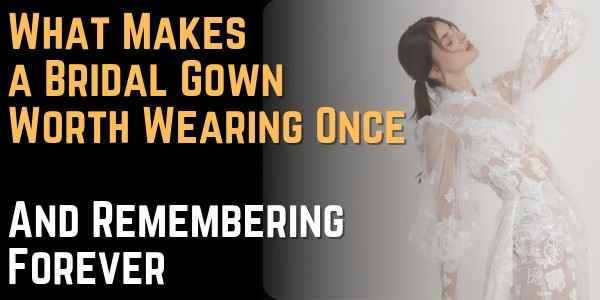
What Makes a Bridal Gown Worth Wearing Once — And Remembering Forever
There is something quietly radical about a garment designed to be worn only once. In a culture increasingly built around repetition, versatility, and cost-per-wear, the wedding gown remains one of the last pieces of clothing most people will ever own that exists purely for a single, irreplaceable moment. A Hazar Haute Couture bridal gown is built entirely around that premise — not as a limitation to work within, but as the very thing that gives the gown its meaning. Understanding why a single-wear garment can be worth more, not less, than something designed for longevity says a great deal about what a wedding gown is actually for.
The Value of a Singular Moment
Most clothing earns its value through use. A coat that keeps you warm through many winters. A dress worn to a dozen different occasions, restyled each time. The wedding gown works differently. Its value isn’t measured in wears — it’s measured in weight. Every stitch, every fitting, every fabric decision exists to serve a few hours on a single day, and the intensity of that purpose is precisely what makes the gown feel different from anything else in a woman’s wardrobe.
This is not a flaw in the economics of bridal fashion. It’s the entire point. A gown asked to do many things — versatile enough for a reception and a rehearsal dinner and a future anniversary — inevitably compromises on all of them. A gown designed to do one thing, on one day, for one bride, can be extraordinary in a way that a compromise never can.
Why “Made Once, Worn Once” Changes Everything
At Hazar, each design is produced only once. Not once per season, not in a limited run of a handful of pieces — once. A single gown, for a single bride, never repeated for anyone else. This is a meaningfully different proposition from most luxury fashion, where exclusivity is measured in scarcity of production runs rather than genuine singularity.
The practical effect of this is that a Hazar gown is designed with total commitment to the individual bride wearing it. There is no need to consider how the silhouette will translate across different body types, how the embellishment will read on ten different women, or how the design might need to be simplified for mass production. The atelier can make decisions in service of one woman’s proportions, one woman’s coloring, one woman’s specific vision for her wedding day — and nothing else has to be accounted for.
This is the real result of “made once, worn once”: a gown that fits not just physically but conceptually — every decision made during its creation was made in service of exactly one outcome.
Craftsmanship That Only Makes Sense at This Scale
The fabrics used at Hazar come from ateliers in France, Italy, and Switzerland — sourced not for a production run but for a single garment. Swarovski crystals, applied by hand, are placed with attention to how they will catch light against one specific bride’s movement, her height, the particular way she will walk down a particular aisle.
This level of consideration is only possible because the gown is not being replicated. A production line optimizes for consistency across many pieces. A singular gown optimizes for correctness in exactly one. The craftsmanship at this level isn’t simply more careful — it’s structurally different, because the goalpost itself is different. There is no “close enough” when a gown exists in exactly one iteration.
The Emotional Weight of Wearing Something That Exists Nowhere Else
There is a particular feeling that comes from knowing that what you are wearing exists nowhere else in the world — not on a rack, not on another bride, not in a future collection reissued for a new season. It is a feeling that most luxury purchases, however exceptional, cannot replicate, because most luxury purchases exist in multiples, however small.
For a bride, this goes beyond aesthetics. The wedding day is already one of the most singular days of a person’s life — unrepeatable, deeply personal, remembered with a clarity few other days achieve. A gown that mirrors that singularity, rather than existing as one interchangeable option among many, becomes part of the memory itself in a way a mass-produced gown, however beautiful, never can.
What This Means When Choosing a Gown
For brides evaluating their options, the question worth asking isn’t simply which gown looks best in isolation. It’s whether the gown was designed with total commitment to them specifically, or as one workable option among a range designed to fit many different brides reasonably well.
The wedding dresses 2026 collections at Hazar are built entirely around this principle — gowns conceived and constructed for the specific bride who will wear them, never repeated, never reissued. A gown made this way carries a different kind of weight, not because of its price or its rarity as a marketing point, but because it was never meant to be anything other than singular.
A wedding gown worn once and remembered forever isn’t a contradiction. It’s the entire design brief.


About Author
