

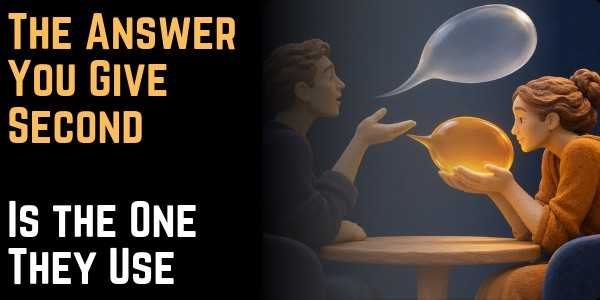
The Answer You Give Second Is the One They Use
You get asked the hard question. You give the answer you prepared. It comes out well.
Then the reporter says nothing. Two seconds. Three. They are looking at you like you missed something. So you start talking again, and this time you are making it up as you go. That improvised bit is what ends up in the story. Media training spends real time on this, because nobody sees it coming the first time.
The silence is the technique. It has been for decades.
What the Reporter Is Actually Doing
They are waiting on purpose.
A reporter knows your first answer is the one you practiced. Practiced answers are tidy. They are also a bit dull, and they rarely say anything new. So the reporter holds back their turn. They sit there with a slightly puzzled look, as if they did not quite follow you.
That look does the work. You assume you explained it badly. You try again, in simpler words, because you want to be understood.
Which is exactly what they were after.
The Second Answer Is the One Used
Now the part that matters.
Your second answer comes out plainer. Shorter words. Fewer careful bits. You drop the caveats because you are trying to be clear.
When the story gets put together, the first answer gets dropped and the second one runs. That is what a reporter is taught to do. The version you worked on loses to the version you improvised.
It is a fair technique, for what it is worth. A plainer answer is usually a better answer, and it is easier for a reader to follow. But your careful version is in a race with your off-the-cuff version, and it is losing.
Why the Silence Is So Hard
Normal talking has tiny gaps. Someone stops, you start. We do it without thinking.
So when a gap runs on for three or four seconds, it feels like something has gone wrong. Your brain says fix it. The quickest fix is to talk.
The reporter does not have to be rude or pushy. They just decline to speak, and your own instincts do the rest. Sitting in silence while somebody looks confused at you is genuinely uncomfortable, and that discomfort is the whole tool.
Knowing about it helps. The silence will still feel awkward when it happens, but an awkward pause you were expecting is much easier to sit through than one that catches you cold.
Anyone booking media training in Dubai for someone facing their first tough interview should get this drilled early. Before the key messages, before the talking points. Good messages fall apart if a quiet moment can pull a different sentence out of you half a minute later.
What to Do When It Happens
Every instinct you have will tell you to rescue the conversation. The job is to finish your answer, stop, hold their eye, and let the quiet belong to them.
Know where your answer ends before you start it. If you have decided what you are going to say, you can hear yourself finish. If you are working it out as you go, the ending will take you by surprise.
Keep it short. A long answer is hard to land cleanly. A short one you can feel yourself complete.
Count if it helps. One, two, three. Three seconds is longer than it sounds, and it is nearly always enough for the other person to pick the conversation back up.
And if the quiet goes on and you really cannot bear it, ask them something. Does that cover what you needed? That hands the turn straight back, and it gives them nothing new to work with.
Short Questions Are a Clue
Here is a tell you can watch for.
Reporters are trained to ask a short question and then stop talking. A long, multi-part question usually gets a vague answer back, and it is often the asker showing off. A short question, three or four words, usually means the opposite.
So a short question followed by silence is usually the technique at work.
Why Reading About It Is Not Enough
Sitting in a real pause feels very different from reading about one.
The reflex to fill a silence is old and strong. Reasoning with it does not help much, any more than reasoning helps with flinching. What changes it is doing it a few times until your body stops panicking.
Frequently Asked Questions
What is the waiting game in an interview?
The reporter stays quiet after your first answer, usually with a puzzled look, so that you keep talking. It is a very old technique, and it is still standard.
Why do they use my second answer?
Because it is plainer. The first one is the rehearsed version. The second comes out in ordinary words, and ordinary words make the better quote.
Should I just stay quiet too?
Yes, once you have actually answered. Finish, look at them, and let the pause sit. There is no rule saying you have to rescue anyone from a silence.
Is it unfair of a reporter to do this?
No. They are trying to get past a prepared line to something a reader can follow, and most of the time that helps you too. A person who talks in press release sentences is harder to believe than one who explains things like a human.
Can I prepare for this?
Yes, and preparing for the gap matters more than polishing the answer. Knowing where your answer ends is what tells you when to stop.
Get Someone to Try It on You
Most interview prep goes into what to say. Almost none covers what happens in the quiet afterward, where a lot of the damage gets done.
So try it out before it matters. Ask a colleague to ask you a hard question, answer it, and have them stare at you in silence for five seconds. Do it five times.
Then your prepared answer has a fighting chance of being the one that runs.


About Author
