

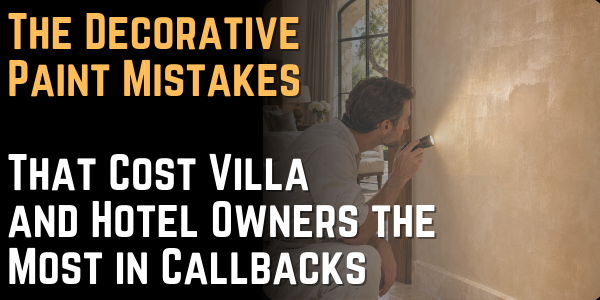
The Decorative Paint Mistakes That Cost Villa and Hotel Owners the Most in Callbacks
A finish that looks flawless at handover can start showing problems within months. Peeling. Cracking. Discolouration. A texture that never quite matched the sample board. For villa and hotel owners, that failure carries a real cost — one that eats into the project budget long after the invoices were meant to be closed. And in almost every case, it traces back to a small number of specification or application errors that were preventable from the start. Decorative paint in Dubai carries a specific set of risk factors tied to the Gulf’s climate, and understanding where those risks concentrate is the clearest way to avoid becoming another callback.
The Substrate Preparation Shortcut
The single most common cause of decorative paint failure has nothing to do with the paint itself. It’s what happens — or doesn’t happen — to the surface before the paint is ever applied. Substrate preparation is unglamorous, time-consuming, and easy to compress under a tight project timeline. It is also the single most important determinant of whether a decorative finish lasts five years or fifty.
A wall that hasn’t been properly cured, that carries residual moisture, or that has surface contamination from previous coatings or construction dust will not hold a decorative finish correctly, regardless of how skilled the applicator is or how good the paint product itself happens to be. The finish may look correct on the day of handover. The failure shows up later — bubbling, delamination, uneven sheen — once the underlying substrate issue has had time to work its way through.
For villa and hotel projects specifically, where decorative paint is often applied over freshly plastered or freshly rendered surfaces on a compressed construction timeline, the pressure to move straight to the decorative finish before the substrate has properly cured is one of the most consistent sources of callback risk on the entire project.
Misjudging the Climate Demands
A decorative paint system designed for a temperate climate doesn’t behave the same way in Gulf conditions. Specify without accounting for that difference, and the mistake shows up reliably — usually within the first year or two of the project’s life.
Humidity swings between air-conditioned interiors and exterior heat, intense UV exposure on any surface with sun contact, and the thermal cycling that comes from significant day-to-night temperature variation all place demands on decorative paint that many standard specifications simply weren’t designed to handle. A finish that hasn’t been formulated or specified with these conditions in mind will show premature fading, chalking, or cracking well before its expected service life is up.
This is particularly relevant for hotel exteriors, villa façades, and any finish facing significant sun or humidity exposure. What matters is that the specification reflects the actual conditions the finish will face — not a generic product data sheet built for an entirely different climate.
Sample Boards That Don’t Reflect Reality
A decorative paint sample viewed in a showroom, under showroom lighting, at a small scale, is a poor predictor of how that same finish will look across an entire wall, under the specific lighting conditions of the actual space. This gap between sample and reality is one of the most frequent sources of client dissatisfaction — and, when the dissatisfaction is significant enough, callbacks to correct or redo work that was technically executed correctly but simply didn’t match expectations.
Textured, deep, metallic, or pearlescent finishes are especially prone to this gap — these effects shift meaningfully with scale and with the quality and direction of light in a given room. A finish that reads as subtle and elegant on a small sample board can come across as overwhelming across a full wall. Or the reverse.
Testing a larger sample panel in the actual space, under the actual lighting the finish will live with, before committing to full application is a step that adds time to the front end of a project but consistently prevents disputes and remediation at the back end.
Inconsistent Application Across a Large Surface
Decorative finishes that rely on hand application — layered plasters, textured coatings, hand-applied metallic effects — are particularly sensitive to consistency across a large surface area, especially when more than one applicator is working on the same project or the same wall.
Variation in technique, pressure, drying time between sections, or the specific batch of material being used can produce visible inconsistency across a wall or a series of walls that were meant to read as a single continuous finish. This is a particular risk on large villa or hotel projects where the sheer surface area requires multiple applicators working simultaneously or in sequence over an extended timeline.
Managing this risk requires clear application protocols, consistent material batching, and — for decorative finishes with significant texture or hand-applied elements — ideally the same applicator or team working across a single continuous surface rather than splitting the work in ways that introduce variation.
Underestimating Maintenance Requirements
A decorative finish that looks extraordinary at handover but that nobody has explained how to maintain correctly is a finish that degrades faster than it should — not because of a specification or application failure, but because of a maintenance failure that could have been avoided with clear guidance.
Different decorative finishes have different cleaning requirements, different sensitivities to certain cleaning products, and different expectations around how they’ll age and what that aging should look like versus what indicates an actual problem. Villa and hotel owners who aren’t given this guidance at handover are left to guess — and guessing often means using the wrong cleaning products, over-cleaning a finish that needs to be left alone, or under-maintaining a finish that requires periodic attention to perform as specified.
Treating Wall Finishes as an Afterthought
Many of the callbacks that trace back to decorative paint actually originate in a broader specification gap: wall finishes being treated as a late-stage decision rather than an integrated part of the interior’s overall material strategy from the beginning.
When decorative paint is specified in isolation, without coordination with the humidity conditions of adjacent spaces, the lighting design that will interact with the finish, or the maintenance regime the rest of the interior is being designed around, the finish is set up to underperform relative to what it’s actually capable of. The projects that avoid callbacks most consistently are the ones where decorative finishes were considered alongside the rest of the material palette from an early stage, rather than selected as a finishing touch once the more consequential decisions had already been made.
Getting Ahead of the Problem
Every one of these mistakes is preventable, and none of them are unusual or exotic — they are the recurring, predictable errors that show up across villa and hotel projects when substrate preparation is rushed, climate demands are underestimated, sample expectations aren’t properly managed, application consistency isn’t controlled, and maintenance guidance is left out of the handover conversation.
For owners and the design and applicator teams working with them, the cost of addressing each of these properly at the specification and installation stage is consistently lower than the cost of the callback that results from skipping them.


About Author
