

How PPF Protects Your Car from Dubai’s Extreme Climate
Dubai’s climate does things to automotive paint that most car owners do not see coming. The damage is gradual, cumulative, and becomes visible only after it has already happened. PPF in Dubai is the most effective response to a set of environmental conditions that are genuinely hostile to unprotected paint – not because the marketing says so, but because the physics of what happens to a car in this climate makes the case on its own.
The Four Climate Factors That Damage Paint in Dubai
Sand and airborne abrasion
The desert sand around Dubai is finer than gravel or road debris in temperate climates. Fine particulate matter gets airborne at low wind speeds and stays suspended in the air at driving height. At 80-120 km/h on the E11, the front surfaces of a car are continuously impacted by particles that individually cause invisible damage but collectively create a pattern of micro-scratches, chips, and surface degradation over months and years.
Construction activity throughout Dubai adds another layer of abrasive material to the air. Cement dust, silica particles from excavation, and debris from active building sites circulate in the same air column that passes over moving cars.
PPF absorbs these impacts. The film surface takes the micro-abrasion; the paint beneath is unaffected.
UV radiation
Dubai’s UV index runs between 8 and 11 from March through October and rarely drops below 6 in winter months. This is substantially higher than northern Europe, where most premium cars are designed and tested.
UV radiation degrades paint chemistry through a process called photo-oxidation. The clear coat – the transparent layer that gives paint its depth and gloss – absorbs UV energy and gradually breaks down at a molecular level. The result is fading, dulling, and eventually chalking of the paint surface. On red, blue, and black cars this process is particularly visible.
Quality PPF film contains UV inhibitors that absorb and block radiation before it reaches the paint. The film degrades the UV energy; the clear coat beneath is preserved.
Temperature extremes
Surface temperatures on a black car parked in the Dubai sun in July or August reach 70-80 degrees Celsius. Interior temperatures in a closed car can exceed 80 degrees. These temperatures accelerate every chemical degradation process affecting paint.
At high temperatures, the bonding between the clear coat and the base coat weakens over time. Contaminants that land on a hot surface – bird droppings, tree sap, industrial fallout – bond more aggressively and cause deeper damage when removed. The paint becomes more vulnerable to everything the environment throws at it.
PPF acts as a thermal barrier. The film absorbs heat before it reaches the paint surface, reducing the temperature differential between the top of the film and the paint layer beneath.
Humidity cycles and water spots
Dubai’s humidity swings between near-zero in dry desert conditions and 90 percent or above during summer months. These cycles stress paint and clear coat as the surface expands and contracts with changing moisture levels.
Water in Dubai – particularly from construction site runoff and some car wash sources – carries mineral content that leaves deposits when it evaporates. Water spots from mineral-rich water bond to paint at elevated temperatures and require aggressive removal methods that themselves damage the surface. On a hydrophobic PPF surface, water beads and runs off before minerals have time to bond.
What PPF Does to Each of These Threats
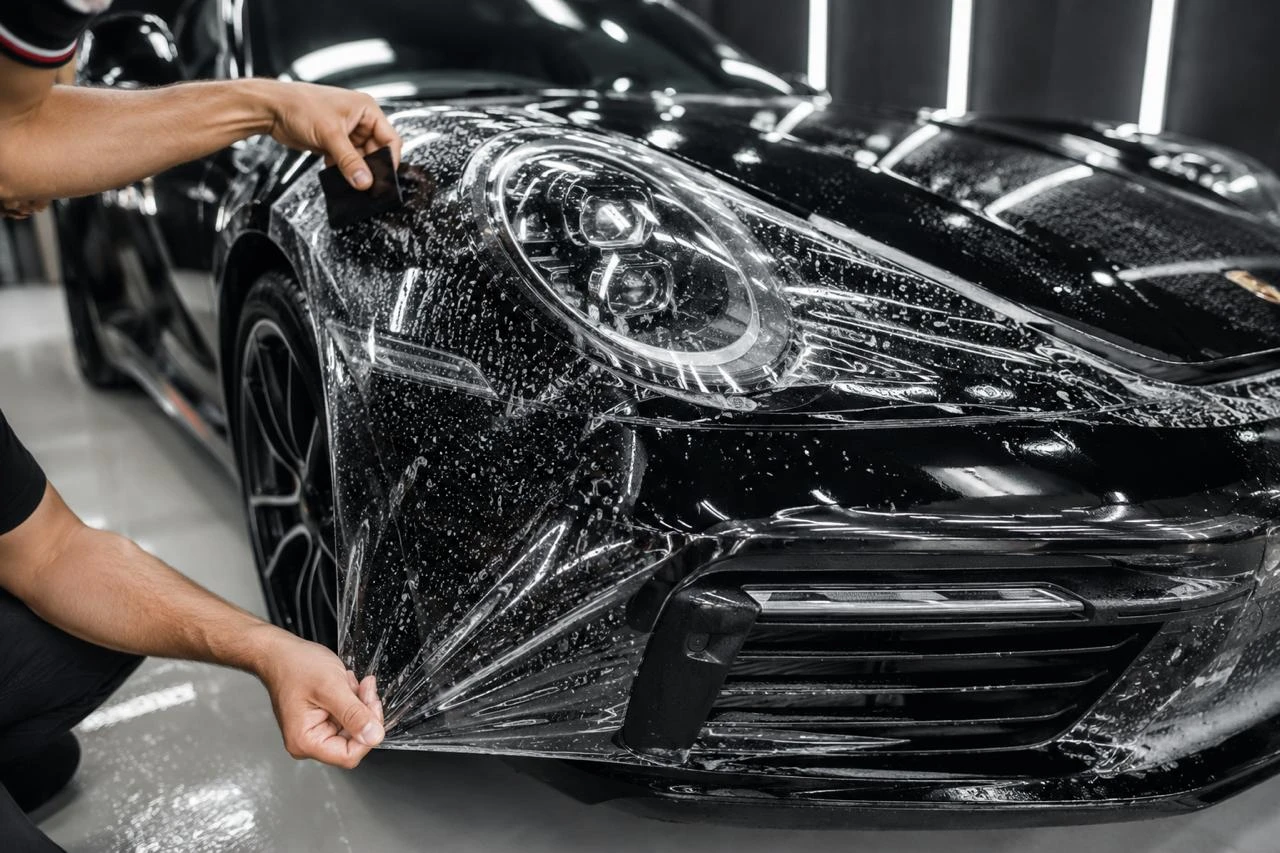
Against sand and abrasion: the film absorbs kinetic energy from particles. Self-healing topcoat on current-generation films closes minor scratches with heat exposure – sunlight alone is sufficient for shallow marks.
Against UV radiation: UV inhibitors in the film chemistry block radiation before it reaches the clear coat. The film itself may yellow slightly over a 10-12 year lifespan, but the paint beneath remains in original condition.
Against heat: the film creates a physical separation between the external heat source and the paint surface. This does not eliminate heat exposure but reduces the peak temperatures the paint experiences and slows the degradation processes those temperatures drive.
Against water spots and contaminants: the hydrophobic surface of PPF means water does not sit on the surface long enough for minerals to bond. Bird droppings and sap on PPF are significantly easier to remove than on bare paint and cause no permanent damage to the film surface if addressed promptly.
What Happens Without PPF: a Timeline
|
Time |
Without PPF |
With PPF |
|
Year 1 |
Fine micro-scratches appear on the front bumper and hood. Paint begins to lose its flawless finish under direct sunlight. |
Paint remains protected from everyday abrasion and retains its original appearance. |
|
Years 2–3 |
Stone chips develop on high-impact areas. UV exposure reduces colour depth, while water spots become harder to remove. |
The film absorbs impacts, blocks UV rays, and helps preserve the original paint and finish. |
|
Years 3–5 |
Clear coat starts showing signs of oxidation. Chips become more noticeable, and colour differences appear on sun-exposed panels. |
Paint stays virtually unchanged beneath the film, with consistent colour and gloss across all panels. |
|
Year 5+ |
Repainting or panel refinishing may become necessary to restore the vehicle’s appearance and value. |
The PPF continues protecting the paint. When professionally removed after 10–12 years, it reveals paint in near-original condition. |
Film Quality: Why It Matters in This Climate
Not all PPF performs equally, and in Dubai’s climate the difference between a quality film and a budget alternative is significant.
The key properties that distinguish films for Dubai’s conditions:
UV inhibitor concentration. Higher UV inhibitor content means longer-lasting protection before the film itself shows degradation. Budget films may yellow within 2-3 years in direct Dubai sun. Quality films from manufacturers like XPEL, 3M, and SunTek maintain optical clarity for 10 years or more.
Self-healing activation temperature. Some self-healing films require hot water or a heat gun to close scratches. Films that self-heal at ambient temperature – including direct sunlight – are more practical in a climate where the car surface is warm for much of the year.
Adhesive stability at high temperatures. At 70-80 degrees surface temperature, adhesives that are not formulated for heat resistance can soften, allowing the film to lift at edges. Quality films maintain adhesive integrity across the temperature range Dubai produces.
Hydrophobic topcoat durability. The hydrophobic properties of a PPF topcoat degrade over time, particularly with frequent washing and sun exposure. High-quality films maintain hydrophobic performance significantly longer than budget alternatives.
Installation in Dubai: What Changes
PPF installation in a hot climate has specific requirements that differ from temperate market conditions.
Temperature-controlled installation environment. Film adhesion and positioning are affected by ambient temperature. Professional studios install PPF in climate-controlled conditions – typically 18-22 degrees Celsius – regardless of the outdoor temperature. Installing PPF in a hot garage produces poor results regardless of film quality.
Surface preparation for contamination. Dubai’s air deposits a fine layer of construction dust and desert particles on car surfaces continuously. Thorough decontamination – clay bar treatment, chemical decontamination, and paint correction if needed – must happen before any film goes on. Contamination sealed beneath PPF causes adhesion failures and visual defects.
Edge sealing in extreme heat. At sustained high temperatures, film edges are more vulnerable to lifting than in cooler climates. Proper edge wrapping – where the film is folded around panel edges rather than cut flush – is more important in Dubai than in any temperate market.
Desert Diamond Detailing trains its installation team specifically for these conditions and backs PPF work with manufacturer warranty of up to 12 years.
Maintenance: Keeping PPF Performing in Dubai
PPF reduces maintenance requirements but does not eliminate them. In Dubai’s conditions, specific maintenance practices extend the performance and life of the film.
- Wash the car regularly to prevent dust and particle accumulation from embedding in the film surface
- Use pH-neutral shampoo – alkaline or acidic products degrade the hydrophobic topcoat faster
- Avoid automatic car washes with brushes – the bristles scratch PPF the same way they scratch paint
- Address bird droppings immediately – they are more acidic in warm climates and bond faster on hot surfaces
- Apply a PPF-compatible sealant every 6-12 months to maintain hydrophobic performance
FAQ
How long does PPF last on a car used daily in Dubai?
Quality film professionally installed lasts 10-12 years in Dubai conditions with proper maintenance. Budget films may show yellowing, lifting, or performance degradation within 3-5 years. The difference in service life makes the quality premium worth paying.
Does PPF work in summer or is the heat too extreme for the film?
Quality PPF is designed to perform across temperature ranges that include Dubai summers. The film may feel softer at extreme surface temperatures but adhesion and protection remain intact. Installation should not happen in high ambient temperatures – but once cured, the film handles Dubai heat without issue.
Can PPF be applied to matte or wrapped cars?
Yes. Matte-finish PPF is available for cars with factory matte paint. PPF can also be applied over a vinyl wrap to protect it. Consult with the installer about the specific product appropriate for the surface.
What happens if PPF gets damaged in an accident?
A damaged section of PPF can be replaced without affecting the surrounding film or the paint beneath. This is one of the practical advantages of PPF over ceramic coating – localised damage is localised in its repair.
Bottom Line
Dubai’s climate creates paint damage through four simultaneous mechanisms – abrasion, UV, heat, and mineral water – that operate continuously and compound over time. PPF addresses all four in a single application that lasts a decade or more.
For a car where paint condition affects either the value or the appearance you expect it to maintain, PPF in Dubai is not optional maintenance. It is the correct response to the environment the car operates in.


About Author
