

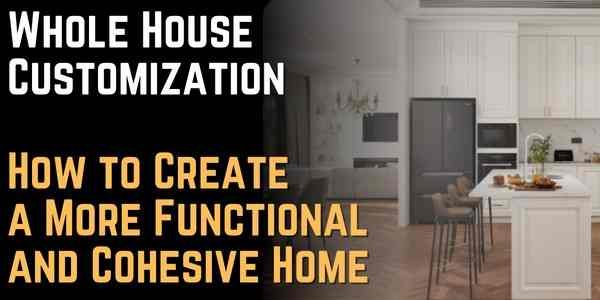
Whole House Customization: How to Create a More Functional and Cohesive Home
A home can have a beautiful kitchen, stylish wardrobes, and attractive furniture. Yet these individual elements do not always create a well-designed home.
The reason is simple. Many residential interiors are planned room by room.
The kitchen may come from one supplier. Wardrobes may be ordered from another. Interior doors, wall panels, and furniture may come from several other companies. Each product can meet its own requirements, but the overall home may lack coordination.
Whole house customization takes a different approach. It looks at the home as one connected living environment rather than a collection of separate rooms.
This approach can improve space planning, create a more harmonious interior, and simplify coordination between different products and suppliers.
Start With How the Home Will Be Used
The first step in a successful whole house customization project is not choosing cabinet colors or furniture styles.
It is understanding how people will use the home.
Designers can consider:
- How residents move between rooms
- Where storage is needed
- How furniture affects circulation
- Where appliances should be placed
- Which areas require more flexibility
- How different rooms connect with each other
This creates a more practical foundation for the design.
For example, an entrance may need concealed storage for shoes and everyday items. An open-plan kitchen may need to connect naturally with the dining and living areas. A bedroom may require a wardrobe designed around both the wall dimensions and the owner’s storage habits.
The design therefore starts with people and space, rather than individual products.
Let Designers Plan the Space Before Production
Customization becomes more effective when designers are involved early.
Instead of selecting products first and trying to fit them into the home later, designers can plan the layout and product dimensions together.
They may review:
- Room measurements
- Wall conditions
- Ceiling height
- Furniture positions
- Cabinet dimensions
- Door locations
- Storage zones
- Appliance locations
This can help prevent problems caused by standard product dimensions.
For example, a standard cabinet may leave an awkward gap beside a wall. A customized unit can be designed to use that space more effectively.
The same principle applies to wardrobes, TV units, entrance storage, and other built-in solutions.
The best customization decisions are often made before production begins.
Make Better Use of Every Part of the Home
One of the practical benefits of whole house customization is better space utilization.
Not every home has a perfect layout. Some have narrow corridors, unusual corners, high ceilings, or limited storage.
Customized solutions can respond to these conditions.
A floor-to-ceiling wardrobe can make use of vertical space. A custom kitchen can turn difficult corners into useful storage. Built-in furniture can combine display and storage without taking up unnecessary floor space.
This approach is especially useful when homeowners want to maximize functionality without making rooms feel crowded.
The principle is straightforward:
Standard furniture fits into a space. Custom solutions are designed around the space.
Create One Design Language Across Different Rooms
A cohesive home does not mean every room should look exactly the same.
Instead, different spaces can share a consistent design language.
This can be achieved through coordinated:
- Colors
- Materials
- Wood tones
- Finishes
- Hardware
- Proportions
- Decorative details
For example, a wood finish used in kitchen cabinetry can be repeated or complemented in living room furniture.
Wardrobes can use finishes that work with the interior doors. Wall panels can introduce similar textures without making the entire home look repetitive.
The result is a home where different rooms have their own functions and character while still feeling connected.
This is one area where whole house customization can offer an advantage over purchasing unrelated products from different sources.
Reduce the Complexity of Multiple Suppliers
Design consistency is only part of the challenge.
Managing multiple suppliers can also make a residential project more complicated.
If the kitchen, wardrobes, doors, wall panels, bathroom vanities, and furniture all come from different companies, the project may require separate:
- Quotations
- Measurements
- Drawings
- Production schedules
- Deliveries
- Installation teams
- After-sales communication
This creates more coordination points.
A whole house customization partner can bring several product categories into one project framework. Companies such as PA Home can coordinate different interior categories within a broader customization approach.
The goal is not simply to have fewer suppliers.
It is to reduce the number of coordination points between design, production, delivery, and installation.
For homeowners, this can make the process easier to manage. For designers and project teams, it can also simplify communication and scheduling.
Think Beyond Individual Products
Whole house customization works best when products are viewed as parts of a larger system.
A kitchen cabinet is not only a storage product. Its dimensions can affect circulation, appliance placement, lighting, and the relationship between the kitchen and dining area.
A custom wardrobe is not simply a place to store clothes. Its position can affect bedroom circulation and the visual balance of the room.
An interior door is not only a functional element. Its color, material, and proportions can influence how adjacent spaces look.
When these relationships are considered during the design stage, individual products can work together more effectively.
This changes the focus from:
“Which product should I buy?”
to:
“How should all these elements work together?”
Whole House Customization Is Not Limited to One Type of Home
Whole house customization can be adapted to different residential projects.
In apartments, customized storage can help make better use of limited space.
In townhouses, coordinated interiors can create consistency across different floors.
In villas, a larger number of rooms can be planned under one overall design direction.
For new homes, customization can be considered from the beginning rather than added room by room.
For renovation projects, it can provide a way to improve several areas at the same time.
The property type may change, but the principle remains the same:
Design the interior around the way the home will actually be used.
Choosing a Whole House Customization Partner
Because whole house customization involves multiple areas, the right partner should offer more than individual products.
Homeowners and project teams should consider whether the company can:
- Support space planning and design coordination
- Customize dimensions and configurations
- Provide multiple interior product categories
- Maintain consistent materials and finishes
- Coordinate production across different products
- Support project-specific requirements
This is particularly important when several customized elements need to be delivered as part of the same project.
PA Home and the Whole House Approach
A company that combines multiple product categories can make this approach easier to implement.
PA Home is a whole house customization manufacturer based in Foshan, Guangdong, China.Its product range includes kitchen cabinets, wardrobes, interior doors, wall panels, bathroom solutions, and custom furniture, all integrated into its whole house customization solutions. For projects with a specific focus on kitchen cabinetry, a dedicated kitchen cabinet manufacturer can also provide more specialized support.
By coordinating these categories within one project, PA Home can support a more consistent design approach while reducing the need to manage multiple independent suppliers.
For homeowners, the benefit can be a more cohesive and functional interior.
For designers and project teams, it can mean fewer coordination points throughout the project.
Conclusion
Whole house customization is not simply about customizing more products.
It is about making better decisions before those products are produced.
By starting with space planning, understanding how people use their homes, coordinating materials and finishes, and reducing unnecessary supplier coordination, homeowners can create interiors that are both functional and visually connected.


About Author
