

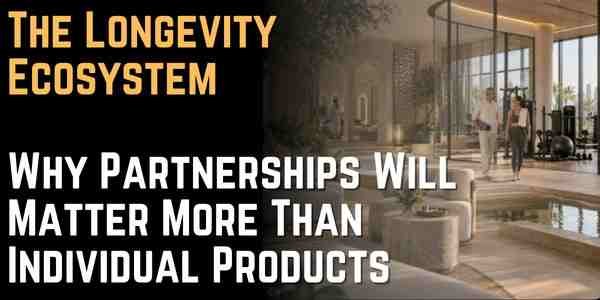
The Longevity Ecosystem: Why Partnerships Will Matter More Than Individual Products
Spend an afternoon at any wellness conference and you’ll meet a dozen founders.
Each one convinced their supplement, their diagnostic test, their wearable is the missing piece of the longevity puzzle.
Plenty of these products are genuinely well made and backed by real science. Almost none of them, on their own, meaningfully change how long or how well someone lives.
That’s the uncomfortable truth sitting underneath this whole industry. No single product can carry the entire promise of a longer, healthier life. What actually moves the needle is the ecosystem that product sits inside. And the businesses figuring that out first are the ones building something that lasts.
Why One Product Is Never Enough
Ageing isn’t caused by one thing, so it can’t be fixed by one thing either.
Genetics. Sleep. Movement. Diet. Stress. Social connection. Environment. Access to good care. All of it interacts in ways scientists still don’t fully understand.
You can eat perfectly and still decline if you’re chronically sleep deprived. You can train hard every day and still see poor outcomes if you’re isolated and stressed out of your mind.
That complexity means any single point solution is, almost by definition, an incomplete answer. A brilliant continuous glucose monitor tells you plenty about metabolic health and nothing about your sleep architecture. A world class sleep program won’t compensate for a sedentary life.
Most people serious about their long term health sense this instinctively, even if they couldn’t explain the biology behind it. Which is exactly why they rarely stick with any single product for long.
Thinking Like an Ecosystem, Not a Product Company
The more interesting players in this space have stopped trying to be the best at one narrow thing.
Instead they act as curators, stitching together a network of specialists, services and experiences around one individual’s needs.
Sometimes that looks like strategic partnerships. Clinics, trainers, nutritionists, therapists and hospitality operators brought together under a single membership, so nobody has to assemble their own patchwork of providers.
Sometimes it’s data integration. Pulling readings from different wearables and lab tests into one coherent picture, even when none of the underlying companies talk to each other.
And sometimes it’s simply physical. A club, a retreat, a residential community that puts multiple services under one roof, so the friction of coordinating five different providers just disappears. A handful of the most ambitious operators in this space are no longer thinking city by city, either. They’re quietly building membership networks that span several major global hubs at once, so a member’s access to the same standard of care and community follows them wherever they happen to be living or travelling that month.
What all three approaches share is a real understanding of what the customer actually wants. Not a slightly better version of one product. A coherent experience across many parts of their health and life at once.
Why Partnerships Beat Building Everything In-House
It’s tempting for an ambitious founder to want to own every piece. Their own diagnostics. Their own clinical team. Their own fitness program. Their own hospitality arm.
In practice this is enormously capital intensive, and it rarely produces excellence across every category at once. Running world class diagnostics takes a completely different skill set than running a world class retreat.
Partnerships let a company assemble genuinely excellent pieces from specialists who’ve spent decades perfecting one narrow domain, instead of trying to become a world class generalist overnight. Pair a respected diagnostics provider with a serious nutrition science team and a proven hospitality operator, and the resulting member experience will almost always beat what any single company could realistically build alone in a reasonable amount of time.
None of this is a new idea in business. Platform companies in other industries figured out long ago that curating a network of specialists often beats owning every link in the chain yourself. What’s new is applying that logic to longevity, a category where the temptation to control every touchpoint runs unusually high, because health is personal and people are understandably nervous about handing it to a stranger.
The Trust You Earn by Not Doing It All Yourself
There’s a trust argument here too, and it’s easy to underestimate.
Because longevity claims are so hard to verify quickly, people are wary of any single provider promising them everything. A well curated ecosystem can say something more honest instead. We haven’t built all of this ourselves, but we’ve done the work of choosing genuinely excellent partners in each area, and we stand behind how they work together on your behalf.
To a skeptical, sophisticated buyer, that framing tends to land better than a single company claiming mastery over an implausibly wide range of disciplines.
That trust compounds over time. As a network matures, weak partners get replaced. New specialists get added as the science evolves. The data connecting everyone gets tighter. The whole offering becomes harder for a new entrant to copy quickly, which is exactly the kind of advantage investors should be hunting for in this space. Not a single proprietary product. A network effect built on curation and earned trust.
What Comes Next
As the longevity industry moves past its early, product obsessed phase, the businesses that last will be the ones that resist the urge to do everything themselves.
They’ll act as thoughtful curators, choosing excellent partners across medicine, fitness, nutrition, mental health and lifestyle, and stitching them into something coherent that actually reflects how ageing works. As one interconnected whole, not a shelf of separate interventions.
The winners in this next chapter of longevity won’t necessarily have the single best product on the market. They’ll be the ones who understood early that in an industry this fragmented and this personal, the ecosystem itself is the product.
Elizabeth Keshchian is Director of International Business Development, currently building a private, community driven longevity concept that brings medical, lifestyle and hospitality partners together under one roof. This piece draws on lessons learned assembling that kind of partner network first hand. Connect with her on LinkedIn.


About Author
