

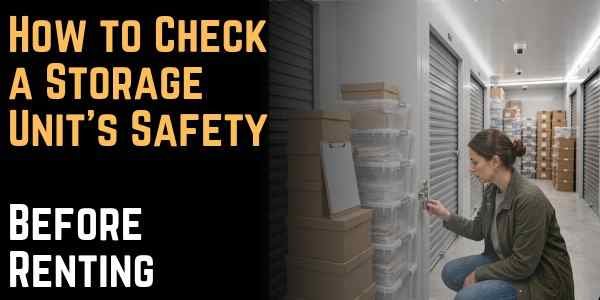
How to Check a Storage Unit’s Safety Before Renting
You’ve found what looks like the perfect place to stash your stuff in Dubai. Great price, convenient location, and the manager on the phone is super polite. But hold on—before you sign on the dotted line and start hauling in your suitcases, there are a few important questions you need to ask yourself (and the rental company). Because keeping your belongings safe isn’t just about the lock on the door—it starts with a careful inspection before you hand over any money.
Storage is a trust business. You’re handing over your laptop, your passport copies, your shopping haul, or a suitcase full of gifts for family—and then walking away. The facility’s job is to make sure that when you come back, everything is exactly as you left it. The problem is that from the outside, a good storage facility and a bad one can look almost identical: same roller doors, same fluorescent lights, same friendly manager. The difference only shows up when something goes wrong. And by then, it’s too late to ask questions.
That’s why the inspection has to happen before you pay, not after. Here’s a simple four-point checklist that’ll help you separate a legit storage facility from a sketchy warehouse.
1. Physical Inspection: See It for Yourself
No matter how good the photos on the website look, they’re no substitute for an in-person visit. Photos are taken on the best day, from the best angle, after a fresh clean-up. They don’t show the damp patch in the corner, the flickering light in the hallway, or the smell that hits you when the door opens. A good service will always let you come check things out. For instance, Keeper straight-up says: “Visit before you pay—we’ll give you guest access so you can walk the facility and pick the right size.” Definitely take them up on that offer! A company that hesitates, makes excuses, or insists you book online first is telling you something important without saying a word.
When you show up at the facility, pay attention to the little details:
Cleanliness and lighting. A dry, clean space with working lights isn’t just about looks—it keeps mold at bay and ensures you won’t trip over someone else’s junk in the dark. Look at the corners, the ceiling, and the floor near the walls. Dust and clutter are annoying; damp and darkness are actual risks to your belongings.
The condition of the unit itself. The walls and floor should feel dry, with no signs of water stains or leaks. Run your hand along the base of the wall—if it feels cold and damp, that’s a problem. Any musty or chemical smells? That’s a huge red flag. Mustiness means moisture, and moisture means mold, warped cardboard, and damaged electronics. Chemical smells could mean the facility is storing something it shouldn’t be.
The general upkeep of the building. Check the gate, the corridors, and the entrance. Is the property well-maintained? Are there broken lights, damaged doors, or rubbish lying around? A facility that neglects the small stuff is probably not careful with the big stuff either.
2. Access System: Who Can Get In, and How?
The biggest mistake people make is thinking a key is all the protection you need. A key can be copied, lost, or borrowed. These days, security is all about digital control. If a company tells you “we just use a lock and have a guard,” that’s your cue to start asking more pointed questions. A guard is only as reliable as the guard on shift, and a lock is only as safe as the last person who had the key.
In a top-notch storage facility, the access system should be sophisticated:
App-only access. This is the gold standard. No lost keys, no forgotten codes—the door only opens through the authorized app on your phone. It also means access can be revoked instantly if your phone is lost or stolen, which is something a physical key can never offer.
Personal access. They should guarantee that only you can access your unit. None of that “we keep a spare key at the front desk” nonsense. Your stuff, your private space. Ask directly: “Can anyone at the facility open my unit without me?” If the answer is anything other than a clear no, keep looking.
Gate control. It’s a lot safer when even getting onto the property requires your approval through the same app. That way, access is controlled in layers: the gate, the building, and your unit door. Each layer is another obstacle for anyone who shouldn’t be there.
Access history. A good system also records when your unit was opened. If access is app-based, you should be able to see your own history—and the facility should be able to show you who entered and when.
3. Surveillance and Monitoring
Security cameras are pretty standard, but what really matters is how they work. “We have cameras” is not a security policy; it’s a sentence. The details are what count:
24/7 recording. Not just “we have cameras,” but actual around-the-clock recording. Ask whether footage is stored, for how long, and whether it’s actively monitored or only reviewed after an incident.
Full coverage. The best setups have cameras covering not just the hallways, but also the entrance and the exterior of the building. The most vulnerable points are often the ones nobody films—the back gate, the loading area, the dark corner by the bins.
Access logs. A system that tracks who comes and goes from the facility adds another solid layer of protection. Combined with app-based entry, logs create a clear record that can be checked if anything is ever disputed.
On-site presence. Some facilities have staff or security on-site during working hours. That’s a plus—but it shouldn’t replace digital controls, only complement them.
4. Transparent Terms in the Contract
Before you put pen to paper, actually read the fine print. A contract is where a professional operator shows their cards. Vague terms, missing clauses, or a “don’t worry about that” attitude are all warning signs. Pay special attention to two things:
Prohibited items. A responsible company will clearly spell out what you can’t store—things like dangerous, flammable, perishable, or illegal items. If you see a clear list like that, it’s a good sign they know what they’re doing. It also protects you: if another tenant stores something hazardous, a facility with strict rules and enforcement is less likely to let it happen.
Insurance and liability. Ask the tough questions: What happens if something damages your stuff? Does their insurance cover it? What are they responsible for, and what falls on you? Get the answers in writing, and check whether you need your own insurance for high-value items. A facility that can explain its liability clearly and without hesitation is usually one that has thought about risk properly.
Payment and notice terms. Also check how billing works, what happens if you’re late with payment, and how much notice you need to give before moving out. These details rarely matter until they suddenly do.
The Bottom Line
Checking security isn’t paranoia—it’s just being smart. A company with something to hide won’t let you freely look around or will dodge your questions. A good facility, on the other hand, will welcome the inspection, answer directly, and show you exactly how access and monitoring work. Your peace of mind is worth the extra time spent inspecting before you rent—not after something goes wrong. 🔒


About Author
