

Peptides, Proteins and Amino Acids: What’s the Difference?
The words “amino acid”, “peptide” and “protein” appear in biology lessons, research headlines and product descriptions. They refer to related molecules, which makes them easy to mix up. Their relationship starts with a simple idea: amino acids can join together in chains.
A peptide is a short chain of amino acids. Proteins are generally larger and consist of one or more chains that take on structures suited to particular biological tasks. Chain length helps explain the terminology, but the order of the amino acids and the molecule’s shape also matter.
Understanding those differences makes it easier to follow a research finding and recognise the limits of what it shows.
Amino acids are the individual units
An amino acid is a molecule that can become part of a peptide or protein. Introductory biology usually focuses on the 20 standard amino acids used to build proteins. Each has its own chemical properties, so they are not interchangeable pieces.
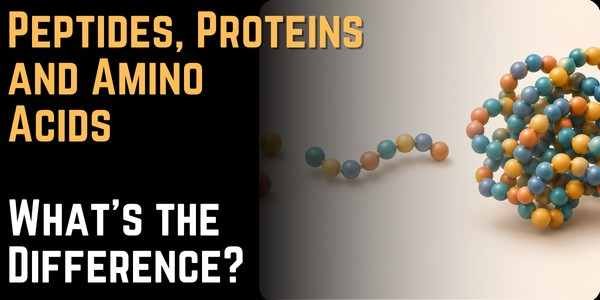
Imagine a string of coloured beads. Each colour represents a different amino acid. The number of beads tells you the chain’s length, while their order tells you its sequence. Two strings can contain the same number of beads and still have different sequences.
The illustration is useful, but real amino acids are molecules with chemical behaviour. Joining them changes how they are arranged and how they interact with their surroundings. A drawing of beads shows the relationship between units and chains; it does not show a complete chemical structure.
Genes provide the instructions for the amino acid sequences of proteins made by cells. This is one reason biology connects discussions of DNA with discussions of proteins: genetic information helps determine what the cell builds.
Peptides are short chains
Amino acids join through chemical connections called peptide bonds. A short chain of connected amino acids is called a peptide. A chain of two is a dipeptide, and a chain of three is a tripeptide. These names describe how many units are joined.
The National Human Genome Research Institute describes peptides as typically containing between two and 50 amino acids. That range is a useful convention rather than a universal boundary between peptides and proteins. In detailed scientific writing, check how the author defines the molecule being discussed.
The word “peptide” alone gives only a broad description. It does not identify a particular sequence or establish what that molecule does. Two peptides of equal length can be different substances, just as two words with the same number of letters can have different meanings.
When reading an article, look for the name of the individual peptide. A finding about one named molecule should not become a claim about every peptide.
Proteins have structure as well as sequence
Proteins are made from one or more amino acid chains, also called polypeptides. Many contain hundreds or thousands of amino acid units. Those chains can fold into complex structures, bringing parts of the sequence close together even when they are far apart along the chain.
The sequence helps determine the structure, and structure is closely connected to function. A flat drawing of a chain therefore tells only part of the story. Scientists also consider its three-dimensional arrangement; the illustration here is a simplified example, not a shape shared by every protein.
Proteins perform many different jobs. Antibodies recognise and bind particular targets. Enzymes help chemical reactions take place. Other proteins provide support within cells or carry substances. These activities depend on the properties of the individual protein.
Size alone does not tell a reader how a molecule behaves. Calling something a protein identifies a broad molecular category; explaining its function requires more information about that specific protein.
Why diagrams can look so different
One science article might show coloured spheres, while another uses a ribbon folded into loops. Both may be illustrating amino acid chains, but they emphasise different features.
A bead-chain illustration is useful for showing individual units and their order. A folded representation draws attention to the overall arrangement. Neither should be mistaken for a photograph of the molecule, and an illustration without a scale cannot establish its actual size.
This also explains why a peptide and a protein may look very different in two separate articles. The artist may have chosen different conventions. Read the caption before assuming that the pictures provide a direct comparison.
Reading research with these distinctions in mind
After identifying the molecule, check what the study actually investigated. Was it examining a chemical interaction, an effect in cultured cells, an animal model or a clinical question in people? Those settings support different kinds of conclusions.
A result from a laboratory experiment needs to be read within the conditions of that experiment. The name of a molecular category cannot establish that a substance is suitable for personal use, and a research finding should not be treated as a treatment recommendation.
For readers moving from introductory biology to specific compounds, a peptide research library can provide a starting point for exploring named molecules and the studies behind them. Follow the references and distinguish the study’s observations from the author’s interpretation.
Where research materials fit
Laboratory materials have a defined intended use. In the UAE, Remy Research supplies research-use-only peptides and laboratory materials. Its products are for in-vitro laboratory research only and are not intended for human or veterinary use.
That distinction remains separate from the chemistry. “Peptide” describes a kind of molecule; “research use only” describes the supplied material’s intended use. Neither term, on its own, establishes an approved medical use.
When you next encounter an unfamiliar peptide or protein in a headline, start with its name and the question the researchers asked. Then look at the study itself. Knowing how amino acids form chains gives you the vocabulary to follow the explanation; the evidence tells you what was actually found.


About Author
