

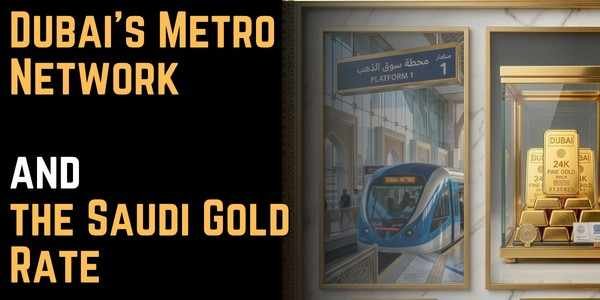
Two Things Every Gulf Resident Tracks Daily — Dubai’s Metro Network and the Saudi Gold Rate
The Gulf region runs on information. Residents across the UAE and Saudi Arabia make daily decisions based on a handful of data points — transport schedules, pricing tools, utility apps — that have become as routine as checking the weather. Two of the most consistently searched pieces of information among Gulf expats are the Dubai Metro network and the gold price in Saudi Arabia. One tells you how to get around the city efficiently. The other tells you whether today is a good day to buy.
This piece covers both in practical terms, with the kind of detail that actually helps rather than a surface-level overview.
The Dubai Metro in 2026 — What Residents Need to Know
Dubai’s Metro is one of the most efficient urban rail systems in the Middle East, and for the millions of residents who use it daily it has become the backbone of city movement. But the network is more layered than most newcomers initially realise, and understanding its structure properly makes a meaningful difference to how well you navigate the city.
The network currently operates 47 stations across two active lines — the Red Line with 35 stations spanning 52.1 kilometres, and the Green Line with 18 stations covering 22.5 kilometres. A third line, the Blue Line, is under construction and expected to add 14 more stations by 2029, connecting Dubai Creek Harbour to Academic City.
The Red Line is the one most residents and visitors use most frequently. It runs along Sheikh Zayed Road and connects the city’s major commercial and tourism destinations in a single corridor — Dubai International Airport Terminal 3, the Burj Khalifa and Dubai Mall station, Dubai Marina, and the UAE Exchange terminus near Jebel Ali. It is also notable for being the world’s longest single automated metro line, a fact that reflects the scale of planning that went into Dubai’s transport infrastructure.
The Green Line covers territory the Red Line does not reach — Dubai’s older heritage districts, including Deira, Bur Dubai, Al Karama, the Gold Souq, and the Spice Souq. For residents in these areas, or visitors wanting to explore the city’s historic side, the Green Line is essential. Transfers between the two lines happen at Union station in Deira or BurJuman in downtown Dubai, with no additional fare charged if the transfer is completed within 30 minutes of the original tap.
Fares are calculated by zone rather than distance or station count. A single-zone journey on a Silver card costs AED 3, two zones AED 5, and three or more zones AED 7.50. Gold class carriages — the first carriage on each train, reserved for women, children, and premium ticket holders — run at double the standard fare. Students and People of Determination receive a 50 percent discount on all standard fares.
For anyone planning a journey, navigating a new route, or simply trying to work out which line serves a particular area, the dubai metro map at UAEWow provides the full 2026 network layout with all 47 stations, fare zones, transfer points, and the planned Blue Line route — updated to reflect the current network as of mid-2026.
Why the Metro Matters More Than Most Residents Initially Think
When people first arrive in Dubai, many default to taxis or ride-hailing apps for getting around. The Metro takes a few weeks to feel comfortable with — learning which line serves which area, understanding where to transfer, working out how the fare zones interact with your regular routes. But residents who make that investment consistently find it transforms their daily commute both in cost and predictability.
A taxi from Dubai Marina to Downtown Dubai during peak hours can run AED 40 to AED 60 depending on traffic. The same journey on the Red Line takes roughly 18 minutes and costs AED 5 on a Silver Nol card. For anyone making that journey five days a week, the annual saving is in the thousands of dirhams. The Metro also runs on a fixed schedule unaffected by road traffic, which matters significantly in a city where peak-hour congestion on Sheikh Zayed Road is a daily reality.
The upcoming Blue Line adds another dimension. When it opens in 2029, it will connect areas of the city currently underserved by rail — including Academic City, Dubai Silicon Oasis, and Dubai Creek Harbour — and is expected to significantly reduce road pressure in those corridors. For residents who have chosen accommodation in those areas partly for lower rents, the Blue Line will eventually make the trade-off much more workable.
Tracking the Gold Price in Saudi Arabia
Shifting from transport to finance, gold remains one of the most actively tracked commodities across the Gulf — and Saudi Arabia is one of the region’s most significant gold markets by both volume and cultural importance.
The Kingdom’s gold market is driven by deep cultural demand. Gold jewellery in Saudi Arabia functions simultaneously as personal adornment, a traditional component of wedding gifts and dowries, and a form of accessible household savings that can be liquidated when needed. Riyadh, Jeddah, and Dammam each have well-established gold souqs and high-end jewellery retailers that handle substantial daily transaction volumes.
Current data shows the Gold price in Saudi Arabia sitting in the SAR 490 to SAR 512 range per gram for 24K gold, with 22K at approximately SAR 441 to SAR 468 per gram depending on the retailer and city. These figures reflect the international spot price converted at the Saudi riyal’s fixed peg to the US dollar — the same mechanism that governs gold pricing across all GCC markets, including the UAE and Qatar.
The Saudi market has its own characteristics that distinguish it from Dubai’s gold retail environment. Making charges in the Kingdom typically run between SAR 8 and SAR 12 per gram for standard jewellery pieces, with more intricate traditional designs attracting higher charges. Bargaining on making charges is standard practice and generally expected, particularly for larger purchases — a dynamic that differs from Dubai’s more standardised retail environment where traders are less flexible on the craftsmanship premium.
The demand pattern in Saudi Arabia also shows stronger preference for 21-karat gold than is typical in the UAE, where 22K dominates. Traditional Saudi jewellery designs — often featuring detailed filigree and pattern work — are frequently produced in 21K, which balances high gold content with the structural durability needed for complex craftsmanship.
What Connects These Two Searches
At first glance, a metro map and a gold price tracker seem like unrelated tools. But they reflect the same underlying reality about expat life in the Gulf: residents here are managing practical complexity across multiple domains simultaneously — commuting in a city still scaling its infrastructure, tracking assets denominated in currencies tied to global commodity markets, navigating systems that reward the residents who take the time to understand them properly.
Both the Dubai Metro and the Saudi gold market have matured significantly over the past decade. The Metro has expanded its network, improved its frequency, and integrated more seamlessly with RTA buses, water taxis, and the Dubai Tram. The Saudi gold market has become more transparent, with live pricing more readily accessible and retail standards more consistent across major cities.
For Gulf residents — whether long-term expats or newer arrivals still orienting themselves — having reliable, up-to-date information on both fronts is genuinely useful. The days of relying on outdated printed maps or asking a jeweller what the rate is are largely behind us. Live tools that update in real-time have made both the metro network and the gold market navigable in ways that simply were not possible five years ago.
The Gulf in 2026 rewards residents who engage with its systems. Both transport and finance are areas where the gap between knowing how things work and not knowing is measurable in real time and real money.


About Author
