

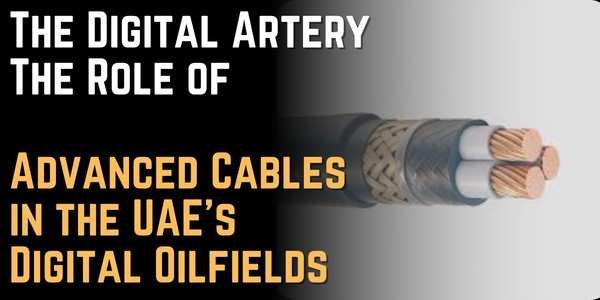
The Digital Artery: The Role of Advanced Cables in the UAE’s Digital Oilfields
The United Arab Emirates (UAE) is a global leader in energy production and is quickly becoming a pioneer in the Digital Oilfield revolution. This transformation moves the industry far beyond traditional heavy machinery, integrating cutting-edge technology like the Industrial Internet of Things (IIoT), advanced data analytics, and remote automation to drastically maximize production, enhance worker safety, and reduce the environmental footprint. Operators across the Gulf are strategically investing in smart infrastructure, including deploying Sustainable Solar Power Solutions to power remote sensors and monitoring stations. But for a digital oilfield to function, it needs a nervous system. The role of cables in this environment has shifted from simple power delivery to providing high-speed, multi-functional connectivity in the harshest conditions on the planet.
Pioneering the Digital Oilfield in the Arabian Gulf
A digital oilfield is a fully integrated ecosystem where real-time data flows seamlessly from thousands of points—from individual wellheads to complex subsea processing units—to a central control hub, often located hundreds or even thousands of miles away. This digital integration enables several mission-critical improvements essential for the UAE’s long-term energy strategy:
- Predictive Maintenance (Pdm): Instead of waiting for equipment failure, smart cables embedded with sensors detect subtle changes in temperature or vibration, flagging potential issues in pumps, compressors, or motors long before a breakdown occurs. This prevents costly downtime and maximizes operational efficiency.
- Remote & Autonomous Operations: Sophisticated data transmission allows engineers in Dubai or Abu Dhabi to control complex valves, regulate flow rates, and even manage drilling rigs remotely. This reduces the number of personnel exposed to high-risk areas, a massive safety benefit.
- Enhanced Oil Recovery (EOR) Optimization: Real-time analysis of reservoir data, often powered by AI, helps pinpoint the optimal strategies for extracting every last drop of oil and gas, directly contributing to the national economy and resource longevity.
- Regulatory Compliance and Environmental Monitoring: Continuous data streams monitor for leaks and anomalies, ensuring compliance with strict UAE environmental regulations and allowing for instant intervention to prevent ecological damage.
The Next Evolution: Hybrid Power and Data Solutions
The space constraints and extreme installation costs of oil and gas sites—especially offshore—have driven the industry toward the mandatory use of Hybrid Cables. These innovative cables consolidate multiple functions into a single, robust jacket, ensuring reliability while minimizing footprint.
Integrated Subsea Umbilicals
In the critical offshore sector of the UAE, a single, highly engineered “umbilical” cable serves as the primary link between surface platforms and deep-sea equipment. These umbilicals are engineering marvels, containing high-voltage power conductors, high-speed fiber optic data strands, and even hydraulic lines required for mechanical operation of subsea valves and blowout preventers. This integrated design is crucial for reliable, all-in-one connectivity in the harsh conditions of the Arabian Gulf seabed.
These specialized cables are often supplied by expert marine cable manufacturers to ensure they can withstand the demanding deep-sea and offshore conditions.
The Cable as a Sensor: Distributed Sensing Technology
One of the most revolutionary advances involves transforming the cable itself into a sensory device. This is achieved by embedding specialized fiber optic strands capable of Distributed Acoustic Sensing (DAS) and Distributed Temperature Sensing (DTS).
- How it Works: By sending a laser pulse down the fiber, the system measures the light that “backscatters” along the entire length.
- Distributed Temperature Sensing (DTS): Analyzes thermal hotspots to detect motor overheating, abnormal reservoir flow, or pipeline friction.
- Distributed Acoustic Sensing (DAS): “Listens” for subtle vibrations, allowing operators to detect the precise location of a pipeline leak, unauthorized activity (e.g., pipeline tapping), or flow assurance issues across many kilometers instantaneously.
Engineered for Survival: The Oilfield Gauntlet
The operational environment of oil and gas fields—from scorching deserts to corrosive offshore rigs—is uniquely destructive to standard industrial components. Digital oilfield cables must be meticulously engineered to resist a combination of intense hazards.
1. Hazardous Zones (ATEX/IECEx Compliance)
Oil and gas extraction involves the constant presence of flammable gases and vapors. Cables operating in these “hazardous zones” must be strictly compliant with international standards like ATEX (European) and IECEx (global). This ensures:
- Spark Prevention: The cable design eliminates any possibility of a spark that could ignite an explosive atmosphere.
- Gas Barrier Protection: Specialized internal filler compounds are used to create a gas-tight seal, preventing explosive gases from migrating through the core of the cable and traveling to safe areas, a crucial safety feature.
2. Chemical and Hydrocarbon Resistance
In drilling and processing operations, cables are frequently exposed to a cocktail of aggressive substances, including crude oil, highly corrosive saltwater, complex drilling muds, and powerful cleaning agents. Standard plastics would rapidly absorb these hydrocarbons, leading to swelling, cracking, and inevitable failure. Premium digital oilfield cables employ advanced jacketing materials, such as robust fluoropolymers or, in deep burial applications, continuous lead sheaths. The lead sheaths are critical because lead is one of the few materials entirely impermeable to hydrocarbons, providing a permanent, hermetic barrier that ensures decades of protection for the internal components.
3. Mechanical Punishment
Whether it is being dragged along the desert floor or hanging from a platform (dynamic risers), these cables are subject to immense tension, crushing, and vibration. Heavy-duty steel wire armoring is essential to protect the delicate fiber optics inside.
The UAE’s Future: Energy Security and Skilled Careers
The shift to a digital oilfield is inextricably linked to the UAE’s goal of long-term energy security and economic diversification. As the region becomes a technological hub for energy innovation, the demand for specialized, high-reliability infrastructure grows exponentially. Global operators consistently rely on local expertise and high-quality products from a premier Cable Manufacturer & Supplier in the UAE. The Arabian Gulf region serves as the ultimate real-world testing ground; a cable capable of surviving its triple threat of intense heat, high humidity, and corrosive salt can be deployed with confidence anywhere in the world.
For individuals looking for career growth in the UAE, the digital oilfield revolution has created a high demand for a new class of professional. This demand aligns perfectly with the mission of uaehelper.com. Opportunities are rapidly emerging for specialists who can bridge the gap between traditional energy engineering and digital technology, including roles in:
- IIoT and Automation Engineering: Designing and maintaining the complex sensor networks and automated control systems that rely on these advanced cables.
- Data and AI Specialists: Analyzing the massive influx of real-time data streaming across the fiber optic cores to optimize extraction and predictive maintenance.
- Specialized Cable Installation and Maintenance Technicians: Professionals trained to install, splice, and maintain fiber-optic-integrated umbilicals and hazardous-area certified cables.
The integrity of the UAE’s energy future depends on the smooth, uninterrupted flow of both oil and critical data. Investing in robust, intelligent cable infrastructure is a commitment to maximizing national resources, ensuring safety, and driving the next generation of highly skilled jobs within the Emirates.
Conclusion: Intelligent Arteries of the Energy World
The digital oilfield represents an epochal revolution in efficiency and safety. Its success is fundamentally supported by the physical integrity of thousands of miles of specialized cable buried in the ground and submerged in the sea. By engineering cables that combine fiber optic intelligence (DTS/DAS) with extreme mechanical resilience, chemical immunity, and mandatory hazardous area certification, the cable industry has delivered a new category of vital infrastructure. These are far more than mere wires; they are the intelligent arteries of the modern energy world, proving that the future of even the most traditional industries in the UAE is decisively digital.
Your Digital Oilfield Questions Answered (FAQs)
- How do cables act as “sensors” in an oilfield?
This is achieved through fiber optic sensing. By sending a laser pulse down an integrated fiber optic strand, a computer can analyze the “backscatter” of light. Changes in that light tell the operator the exact temperature (DTS) or acoustic vibration (DAS) at every meter along the cable, effectively turning the whole cable into a sensor. - What does an “umbilical” cable do?
An umbilical is a composite cable used in offshore oil and gas operations. It serves as the “lifeline” to subsea equipment, carrying high-voltage electrical power, high-speed fiber optic data, and hydraulic fluid for valve control all in one heavily armored package. - Why is a lead sheath used in oilfield cables?
A lead sheath provides a permanent, hermetic metal seal because lead is one of the few materials completely impermeable to hydrocarbons (oil and gas). This protects the cable’s insulation from chemically-induced deterioration over decades of burial. - What is ATEX certification for cables?
ATEX is a European safety standard (often used globally alongside IECEx) for equipment in explosive atmospheres. ATEX-certified cables are designed and tested to prevent them from causing a spark, overheating dangerously, or allowing flammable gases to travel through them, thereby preventing explosions in hazardous oilfield zones.


About Author
