

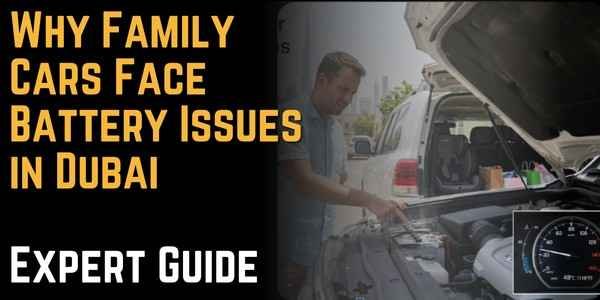
Why Family Cars Face Battery Issues in Dubai | Expert Guide
Dubai’s heat is brutal on any car battery. But family cars face a much harder problem. A Toyota Land Cruiser, Kia Carnival, or Nissan Patrol carries far more electrical load than a regular commuter car. It runs rear AC, entertainment screens, USB ports, safety cameras, and seats a full family. All of that puts enormous pressure on one battery.
According to a study published in the Journal of Power Sources (2019), lead-acid battery capacity drops by up to 30% when ambient temperatures exceed 40°C, and internal temperature during a hot drive in Dubai can push well beyond that.
The result is simple: family car batteries last just 18 to 24 months on average, compared to 4 to 5 years in Europe. Some fail in as little as 12 months. Here is exactly why.
9 Reasons Family Cars in Dubai Burn Through Batteries Faster
1. Extreme Heat Destroys Electrolyte Fluid
Battery fluid evaporates fast in extreme summer heat. Under-bonnet temperatures in open parking lots near Ibn Battuta Mall or schools across Mirdif regularly hit 70 to 80°C. Once fluid drops below the minimum level, the internal plates corrode, and the battery fails.
Large SUV engine bays trap more heat. Bigger batteries also take longer to cool down. Test battery electrolyte level every 3 months between April and October. Park in covered areas whenever possible.
2. The AC System Runs at Full Load All Day
A family car AC compressor draws 1,500 to 2,500 watts of electrical load continuously. In stop-and-go traffic on Sheikh Mohammed Bin Zayed Road, the alternator cannot always keep up. The battery covers the gap.
Family cars with rear AC units, such as the Toyota Alphard and Hyundai Staria, carry a second evaporator that roughly doubles this load. Run the fan on a lower setting for the first 3 minutes after starting to let the alternator stabilise before the full AC demand kicks in.
3. Short School Runs Prevent Full Recharge
A battery needs 20 to 30 minutes of continuous driving to fully recharge after a cold start. The typical school run is 5 to 15 minutes, twice a day. That is not enough.
Over 2 to 4 weeks, this repeated undercharge causes sulfation, where lead sulphate crystals harden on the battery plates and permanently reduce capacity.
Research by Battery University confirms that chronic partial charging is one of the top causes of early battery failure. Take one longer drive per week of at least 30 minutes on open roads like Al Ain Road or Expo Road.
4. Entertainment and Safety Systems Add Constant Drain
Modern family SUVs like the GMC Yukon, Ford Expedition, and Chevrolet Tahoe come loaded with electrical systems. Running 4 USB devices at once draws 20 to 40 watts. Rear entertainment screens add another 60 to 100 watts. Parking sensors, blind-spot monitors, and 360-degree cameras all draw continuously.
When these run while the car idles during school pickup or a drive-through queue, the battery discharges faster than the alternator recovers. Switch off rear screens and unplug chargers when the engine is off.
5. Parasitic Drain Kills Batteries During Holidays
Parasitic drain happens when electronics keep drawing power after the car is switched off. In fully loaded family SUVs, the most common culprits are aftermarket alarm systems, dash cameras in parking mode, connected telematics modules, and audio amplifiers that never enter sleep mode.
A healthy car should draw no more than 50 milliamps at rest. Anything above 100 milliamps drains a full battery within 3 to 7 days. This is a major problem during Eid holidays or summer travel, when many families leave their cars parked for 2 to 4 weeks. Have a technician run a parasitic drain test before replacing the battery, or the same failure will happen again.
6. Terminal Corrosion Breaks the Connection
Corrosion builds up as white crust on the battery terminals. It acts as an insulator and interrupts the electrical connection. In coastal communities like JBR, The Palm, and Dubai Marina, salt air from the Gulf makes corrosion worse, especially during the humid season between August and October.
Even partial corrosion causes voltage drops, dashboard warning lights, and erratic electronics. Clean terminals every 4 to 6 months with a baking soda and water solution, then apply terminal protection spray.
7. Undersized Batteries Cannot Handle the Load
Many car owners replace their battery with the cheapest available option. For a small city car, this is a minor issue. For a large family SUV running dual AC, rear entertainment, and five or six devices, it causes early failure.
Match the battery to the manufacturer’s specification:
- Toyota Land Cruiser 300: minimum 90Ah AGM
- Kia Carnival and Hyundai Staria: 70 to 80Ah MF or AGM
- GMC Yukon and Chevrolet Tahoe: 78 to 90Ah, 750+ CCA
- Nissan Patrol Y62: 85 to 95Ah, high CCA rating
AGM (Absorbent Glass Mat) batteries outperform conventional flooded batteries in extreme heat. They handle vibration better, tolerate heat more effectively, and are compatible with start-stop systems.
8. A Failing Alternator Destroys New Batteries Fast
A healthy alternator outputs 13.8 to 14.4 volts at normal engine speed. Slow traffic on Al Ittihad Road or Financial Centre Road, it often runs below peak output. The battery carries more load as a result.
If the alternator is already weak, no replacement battery will last. Signs include dimming headlights at idle, infotainment resetting, and a new battery going flat within days.
Always test the alternator when replacing the battery. The test takes under 10 minutes and prevents replacing a good battery because of a bad alternator.
9. Batteries Expire Faster Than Owners Expect
Manufacturers rate most batteries for 3 to 5 years under normal conditions. A family car battery delivers 18 to 30 months of reliable service. High-demand SUVs parked in open lots and used for short trips land at the lower end.
A battery at 75% health in March deteriorates sharply when summer arrives. Most families only discover this when the car will not start in July or August. Replace the battery proactively at 18 months if your vehicle matches any of the high-stress categories above. A quality AGM battery costs AED 300 to AED 700. Emergency roadside assistance, towing, and a wasted day cost far more.
How to Extend Family Car Battery Life: 7 Proven Practices
To extend family car battery life, apply these 7 practices every season:
- Park in covered areas such as mall parking or residential basements during the summer months
- Test battery health every 3 months between April and October, not only when the car struggles to start
- Combine short trips into at least one long drive per week to complete a full recharge cycle.
- Switch off rear screens and USB chargers whenever the engine is off.
- Clean battery terminals every 4 to 6 months and apply terminal protection spray
- Install the correct Ah and CCA rating for your specific vehicle model.
- Test the alternator alongside the battery at every inspection or replacement.
When to Call a Professional: 5 Signs Your Battery Needs Immediate Attention
Replace your battery immediately if you notice any of these 5 warning signs:
- Slow engine cranking on startup, especially in the morning
- Dashboard battery warning light that stays on after starting
- Swollen or bloated battery case from heat damage and internal gas buildup
- White crust on battery terminals indicates active corrosion
- Erratic electronics, including infotainment resets, slow windows, or flickering interior lights
Do not wait. A failing battery that breaks down on the Dubai to Abu Dhabi highway or near Al Maktoum Bridge during peak hours creates real safety risks, especially for families with children on board.
Seasonal Battery Advisory for Dubai Families
April to June: Schedule a battery and charging system test before temperatures exceed 40°C. This is the best window to replace a marginal battery before peak stress begins.
June to September: Minimise optional electrical load. Avoid leaving the car in accessory mode. Check terminal conditions monthly and park in covered areas wherever possible.
October to November: High humidity near Marina, JBR, and The Palm accelerates corrosion during this period. Clean and protect terminals.
December to February: Battery performance improves. Use this window to test battery health and plan proactive replacement if the battery is approaching 18 months of age.
Trust Sayara Battery for Family Car Battery Solutions in Dubai
Sayara Battery specializes in battery testing, installation, and Amaron battery replacement in Dubai for all major family car brands, including Toyota, Kia, Hyundai, Nissan, GMC, Chevrolet, and Ford. Every replacement includes a full charging system check to fix the root cause, not just the symptom.
Contact Sayara Battery today to book a battery health check before the next summer season. Protect your family’s safety and your vehicle’s reliability with a team that understands Dubai’s demanding conditions.


About Author
