

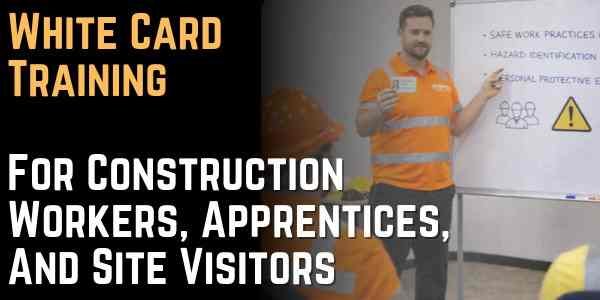
White Card Training For Construction Workers, Apprentices, And Site Visitors
Heavy machinery, moving cars, electrical systems, tools, supplies, and people often work together on construction sites, which are dynamic workplaces. Numerous safety issues might arise from even a very minor undertaking. Because of this, before starting their profession, everybody joining the construction industry must comprehend the fundamentals of workplace health and safety.
An introduction to fundamental construction safety information is given during White Card training. It applies not just to seasoned personnel but also to apprentices and other individuals who may have to attend building sites. The training makes workplaces safer and more orderly by fostering a shared awareness of risks, roles, communication, and emergency protocols.
Establishing A Basis For Construction Safety
Understanding that risks may alter as work advances is the first step towards construction safety. It is possible for excavations to occur, equipment to be moved between work zones, temporary electrical systems to be erected, and many trades to operate in close proximity.
Participants who successfully complete White Card NSW programme have an understanding of basic safety principles that are applicable in construction settings. Workplace health and safety obligations, typical construction risks, risk controls, safety signs, personal protective equipment, incident reporting, and emergency protocols are all often included in training.
Instead of just following instructions without understanding their objective, this fundamental knowledge may assist workers in comprehending why site rules exist.
Assisting Employees In Various Roles
There are many different tasks that construction workers must do, and their exposure to risks varies greatly. While a labourer may often touch materials or operate near moving equipment, a carpenter may encounter dangers related to power tools and working at heights. Painters, plumbers, electricians, and other tradespeople face risks unique to their jobs.
White Card training does not take the place of job orientation or task-specific training. Rather, it offers a more comprehensive safety basis that may facilitate further training offered by site managers and employers.
White Card Sydney training may be a crucial component of being ready to join construction settings with a better grasp of workplace duties and fundamental risk awareness for persons starting employment in the city.
Assisting Apprentices In Developing Better Safety Practices
Many times, apprentices are first-time visitors to construction sites. Even though they may have technical knowledge from formal education, a dynamic workplace presents real-world difficulties that are sometimes beyond the scope of technical training.
Early adoption of safe practices may have a lasting impact on how apprentices approach their jobs. They must comprehend the significance of adhering to site protocols, paying attention to supervisors, wearing the proper safety gear, reporting dangers, and refraining from doing duties for which they lack the necessary training or authorisation.
Before dangerous behaviours have a chance to form, these concepts are introduced via White Card training. Additionally, it helps boost apprentices’ confidence when discussing risks or asking queries about novel circumstances.
Getting Site Visitors Ready For Construction Environments
Not every individual who walks onto a building site is a tradesman. Engineers, consultants, project representatives, contractors, inspectors, delivery staff, and other visitors may spend time near construction works, depending on the project and their tasks.
A jobsite differs from a typical business setting, even for those who are not actively involved in construction activity. There may be limited areas, conditions might change suddenly, and site management guidelines must be strictly observed.
Completing White Card training Sydney may help a person recognise risks and comprehend the safety standards that come with visiting building sites where White Card rules apply.
Identifying Risks Before They Turn Into Incidents
One of the most important abilities in any job is the ability to identify hazards. Falling items, uneven terrain, hard labour, moving machinery, electrical equipment, dangerous materials, loud noises, dust, and work done at heights are all prevalent hazards on construction sites.
Participants in training are encouraged to be aware of their surroundings and identify potentially dangerous circumstances. Additionally, it presents the idea of managing risks instead of only responding to an event.
Employees should be aware that recognising a danger is only one step in the process. In order for appropriate control measures to be evaluated and put into place, hazards should be notified via the proper workplace procedures.
Establishing A Culture Of Shared Safety
Everyone who enters a building site must participate for it to be safer. When it comes to adhering to workplace protocols and reacting promptly to dangers, experienced craftsmen, apprentices, contractors, supervisors, and pertinent visitors all have obligations.
A common foundation for comprehending building safety is established via White Card training. It doesn’t remove risks or take the role of site-specific supervision, training, and safe work practices. Rather, it assists individuals in arriving with fundamental information that may be reaffirmed throughout their stay.
Appropriate safety training may promote increased awareness, clearer communication, and more responsible behaviour on the job site for workers starting a construction career, apprentices gaining practical experience, and others whose jobs require access to construction sites.


About Author
