

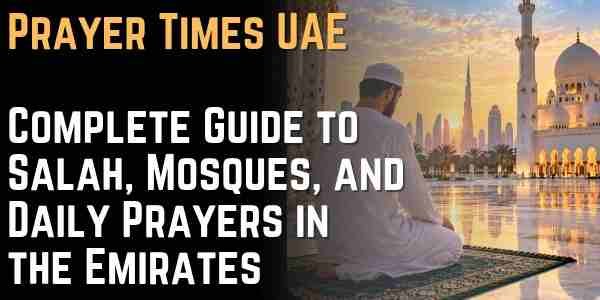
Prayer Times UAE: Complete Guide to Salah, Mosques, and Daily Prayers in the Emirates
☪ UAE HELPER • DAILY SALAH GUIDE
UAE Prayer Times Today
Find today's Fajr, Dhuhr, Asr, Maghrib and Isha prayer times across the United Arab Emirates.
NEXT PRAYER IN Dubai--:--:--
Today's Prayer Schedule
United Arab Emirates (GST, UTC+4)
Monthly Prayer Times Calendar
Daily Salah timings for Dubai
Loading…
Date Fajr Sunrise Dhuhr Asr Maghrib Isha Loading monthly timetable…
Source: AlAdhan Prayer Times API (Gulf Region calculation method). Times are estimates and may differ from official UAE authorities or your local mosque. Sunrise is shown for reference and is not a separate obligatory prayer. Always confirm important timings locally.
Prayer Times in the UAE
Muslims in the United Arab Emirates observe five daily obligatory prayers: Fajr before sunrise, Dhuhr after midday, Asr in the afternoon, Maghrib after sunset and Isha at night. Exact prayer times vary by date and location. Use the city selector above to check daily and monthly prayer times for Dubai, Abu Dhabi, Sharjah, Ajman, Fujairah, Ras Al Khaimah, Umm Al Quwain and Al Ain.
Frequently Asked Questions
What time is Fajr in Dubai today?
Select Dubai above to see today's calculated Fajr time, updated automatically each day.
What is Maghrib time in Abu Dhabi?
Select Abu Dhabi from the city dropdown. The daily prayer schedule will display today's Maghrib time.
Are prayer times the same throughout the UAE?
No. Prayer times can vary between emirates and cities due to their geographic locations.
Are these official UAE prayer times?
No. This page uses an independent calculation service. Official timetables or local mosque announcements may differ.
The UAE is home to a diverse Muslim population representing different nationalities, cultures, and Islamic traditions. Despite these differences, the five daily prayers remain a central part of Muslim life. Mosques across the country welcome worshippers, the call to prayer is heard throughout residential and commercial neighborhoods, and many workplaces, shopping malls, airports, and public facilities provide dedicated prayer spaces.
For residents and visitors searching for Prayer Times UAE, it is helpful to understand more than the daily prayer schedule. Knowing the meaning of each prayer, how prayer schedules are determined, where to find mosques, and how Islamic worship fits into everyday life can make a meaningful difference.
This comprehensive UAE prayer guide covers everything from the five obligatory prayers and Islamic calendar to mosque etiquette, Friday congregational prayers, Ramadan worship, and practical advice for Muslims living or traveling in the Emirates.
Understanding the Importance of Salah in the UAE
Salah, also called Salat or Namaz, is one of the Five Pillars of Islam. It represents a direct connection between a Muslim and Allah and is performed regularly throughout the day.
For practicing Muslims, Salah is not simply a religious activity reserved for special occasions. It is a daily responsibility that encourages discipline, gratitude, spiritual reflection, and awareness of faith.
The five obligatory prayers are:
Fajr: The prayer associated with the beginning of the day.
Dhuhr: The prayer performed after the sun passes its highest point.
Asr: The afternoon prayer.
Maghrib: The prayer performed after sunset.
Isha: The night prayer.
Each prayer has its own religious significance and prescribed number of obligatory units, known as rak’ahs.
Islam is the official religion of the United Arab Emirates, and its influence is visible in the country’s architecture, cultural traditions, public institutions, and community life.
Beautiful mosques are found throughout Dubai, Abu Dhabi, Sharjah, Ajman, Fujairah, Ras Al Khaimah, and Umm Al Quwain. In many neighborhoods, residents can reach a local mosque within a short walk or drive.
At the same time, the UAE is an international destination where people from many religious backgrounds live and work together. Understanding Islamic prayer traditions is therefore useful not only for Muslims but also for non-Muslim residents, employers, tourists, and visitors.
The Five Daily Islamic Prayers Explained
The five daily prayers form the foundation of a Muslim’s regular worship. Each prayer serves a different purpose within the daily routine and provides an opportunity to pause from ordinary responsibilities.
1. Fajr Prayer: Beginning the Day with Worship
Fajr is the first obligatory prayer of the Islamic day. It takes place before sunrise and consists of two obligatory rak’ahs.
For many Muslims in the UAE, Fajr represents a peaceful beginning to the day. Before offices open, roads become busy, and commercial activities begin, worshippers gather in mosques or pray at home.
The prayer emphasizes spiritual awareness, self-discipline, and the importance of beginning daily activities with remembrance of Allah.
Some residents make Fajr part of a wider morning routine that includes reading the Quran, making supplications, exercising, or preparing for work.
For families, it can also provide an opportunity to introduce children to regular worship and Islamic values.
Muslims who work early shifts, including healthcare professionals, airport staff, security workers, and transportation employees, may need to organize their morning routines carefully to accommodate prayer.
2. Dhuhr Prayer: A Spiritual Pause During the Day
Dhuhr is the second obligatory prayer and consists of four obligatory rak’ahs.
It provides a moment of reflection during the working or studying day.
In the UAE, many office buildings, universities, hospitals, shopping centers, and public institutions have designated prayer facilities. These spaces make it easier for Muslims to fulfill their religious obligations without traveling far from their workplace or daily activities.
For office employees in Dubai’s business districts or Abu Dhabi’s commercial areas, a nearby prayer room can be particularly convenient.
Dhuhr also illustrates an important aspect of Islamic worship: religious responsibilities continue alongside professional, educational, and family commitments.
Many Muslims use this prayer as an opportunity to refocus their attention and return to their responsibilities with a calmer mindset.
3. Asr Prayer: Reflection During the Afternoon
Asr is the third obligatory prayer and consists of four obligatory rak’ahs.
It takes place during the afternoon and is especially relevant to people managing busy work schedules.
For students, Asr may fall between classes, extracurricular activities, or the journey home. For employees, it may occur during the later part of the working day.
Because UAE residents follow different professional schedules, including traditional office hours, retail shifts, and flexible working arrangements, access to suitable prayer facilities can be important.
Many Muslims view Asr as a reminder to remain mindful of their faith while managing the responsibilities of everyday life.
The prayer also encourages consistency, particularly when work or personal commitments become demanding.
4. Maghrib Prayer: Worship After Sunset
Maghrib is the fourth obligatory prayer and consists of three obligatory rak’ahs.
It is performed after sunset and marks an important transition from daytime activities to the evening.
In many UAE households, Maghrib is closely connected with family routines. Parents may return from work, children may finish their activities, and family members may gather for worship.
During Ramadan, Maghrib has additional significance because Muslims observing the fast break it after sunset.
Mosques, homes, hotels, and community organizations across the UAE often arrange iftar gatherings during the holy month.
These gatherings reflect the strong tradition of hospitality and charitable giving associated with Ramadan in the Emirates.
Outside Ramadan, Maghrib continues to provide a valuable opportunity for family worship and reflection.
5. Isha Prayer: Ending the Day with Remembrance
Isha is the fifth obligatory prayer and consists of four obligatory rak’ahs.
It is performed at night and completes the cycle of five daily obligatory prayers.
For many Muslims, Isha offers a peaceful conclusion to the day’s responsibilities.
Some worshippers attend their neighborhood mosque, while others pray at home or in an appropriate prayer facility.
During Ramadan, many mosques hold additional congregational prayers known as Taraweeh after Isha.
These prayers attract large numbers of worshippers and contribute to the distinctive spiritual atmosphere experienced throughout the UAE during the holy month.
Isha also reminds Muslims of the importance of maintaining their relationship with Allah regardless of how busy the day has been.
How Islamic Prayer Schedules Are Determined in the UAE
Islamic prayer schedules are connected to the position of the sun rather than a fixed daily clock schedule.
As the sun’s apparent position changes throughout the year, the beginning of each prayer period also changes.
Several astronomical factors influence prayer calculations, including:
The geographical latitude and longitude of a location.
The date and the sun’s seasonal movement.
The solar angle used to identify dawn.
The method used to determine the beginning of the night prayer.
Jurisprudential differences in determining the afternoon prayer.
Local religious authority guidance and approved calculation conventions.
These factors explain why prayer schedules can vary between different countries and even between cities within the same country.
The UAE follows Gulf Standard Time, which is UTC+4 throughout the year. The country does not observe daylight saving time.
Although the seven emirates share one civil time zone, their geographical locations are not identical. Consequently, prayer calculations for Abu Dhabi, Dubai, Fujairah, and other locations can produce slightly different results.
For this reason, Muslims should use a prayer schedule appropriate to their location and the religious calculation method they follow.
Why Different Prayer Apps May Show Different Results
Residents sometimes notice differences when comparing prayer schedules from mobile applications, websites, mosque announcements, and printed calendars.
These differences do not necessarily indicate that one application is malfunctioning.
They may result from different calculation methods, astronomical conventions, location coordinates, or religious interpretations.
For example, methods used to determine the beginning of Fajr and Isha may differ between organizations.
The calculation of Asr can also vary according to the school of Islamic jurisprudence being followed.
A location-based application may additionally calculate prayer periods using coordinates that differ from those used in an official city timetable.
When accuracy is particularly important, worshippers should consult the timetable issued or endorsed by the relevant local religious authority.
In Dubai, the Islamic Affairs and Charitable Activities Department (IACAD) is an important official source of religious guidance. In Abu Dhabi, the General Authority of Islamic Affairs, Endowments and Zakat provides religious services and guidance.
Prayer Practices Across the Seven Emirates
The UAE consists of seven emirates, each with its own communities, landmarks, residential districts, and mosques.
While the religious foundations of Salah remain the same throughout the country, daily routines and access to prayer facilities can vary according to location.
Dubai: Prayer in a Busy International City
Dubai is one of the world’s most internationally connected cities, attracting tourists, entrepreneurs, students, and professionals from numerous countries.
Muslims living in Dubai can find mosques and prayer facilities across areas such as Deira, Bur Dubai, Al Barsha, Jumeirah, Business Bay, Dubai Marina, and Jumeirah Lake Towers.
Many major shopping destinations and transportation facilities also provide prayer rooms.
For example, residents visiting large malls can usually locate prayer facilities through shopping-center directories or information desks.
Visitors should remember that a mosque and a general-purpose prayer room may have different access arrangements.
Some mosques are primarily intended for worship, while others also offer educational activities or visitor programs.
Dubai’s busy traffic conditions make planning especially useful for people who prefer congregational prayer at a particular mosque.
Those commuting between residential and business districts may find it practical to identify prayer facilities near both their home and workplace.
Abu Dhabi: Worship in the UAE Capital
Abu Dhabi is the federal capital of the UAE and is known for its cultural institutions, government facilities, residential communities, and impressive mosque architecture.
One of its most famous landmarks is the Sheikh Zayed Grand Mosque.
The mosque is internationally recognized for its architectural design and importance as a place of Islamic worship and cultural understanding.
Beyond major landmarks, Abu Dhabi has neighborhood mosques serving communities across the city and surrounding residential areas.
Residents working on Al Maryah Island, living on Al Reem Island, or visiting Khalifa City can find prayer facilities appropriate to their locations.
Abu Dhabi also includes areas such as Al Ain and Al Dhafra, where residents should use locally relevant prayer information rather than assuming that one city schedule applies identically across the entire emirate.
Sharjah: A City with a Strong Islamic Cultural Identity
Sharjah is widely associated with Islamic heritage, education, museums, and cultural preservation.
The emirate contains numerous mosques, including prominent architectural landmarks that attract both worshippers and visitors.
For Muslims living in Sharjah and commuting to Dubai, prayer planning can become part of the daily journey.
Traffic between the two emirates can be substantial during commuting periods, so knowing the location of suitable prayer facilities along a regular route may be helpful.
Sharjah’s residential communities also provide opportunities for families to participate in congregational worship and religious education.
The emirate’s cultural emphasis makes it an interesting destination for visitors wishing to learn more about Islamic architecture and local traditions.
Ajman: Convenient Community Mosques
Ajman is the smallest emirate by area and includes established residential neighborhoods, commercial districts, and coastal communities.
For many residents, neighborhood mosques are an important part of community life.
Families living in Ajman may attend local mosques regularly and participate in community activities during Ramadan and Islamic holidays.
People commuting between Ajman, Sharjah, and Dubai should remember that prayer arrangements may need to account for their actual location during the day.
Ras Al Khaimah: Prayer Across Urban and Mountain Communities
Ras Al Khaimah combines urban neighborhoods, coastal areas, desert landscapes, and mountainous terrain.
Mosques serve both established residential districts and communities located farther from the main city.
Visitors exploring Jebel Jais or other outdoor attractions should plan ahead, particularly when traveling away from urban facilities.
Checking the location of nearby mosques, suitable stopping points, and essential amenities can make a day trip more comfortable.
Because the emirate includes varied terrain and locations, travelers should not automatically assume that the main city’s schedule is the best reference for every remote destination.
Fujairah: Prayer on the UAE’s Eastern Coast
Fujairah lies on the eastern side of the UAE, along the Gulf of Oman.
Its geographical position differs from that of Dubai and Abu Dhabi, making location-specific prayer information particularly relevant.
The emirate is known for its mountain scenery, coastal communities, and historic Islamic landmarks.
Visitors may encounter both modern neighborhood mosques and older sites reflecting the region’s religious heritage.
Muslims traveling from Dubai or Sharjah to Fujairah should select the correct location when checking prayer information.
Umm Al Quwain: Worship in a Quieter Coastal Emirate
Umm Al Quwain is known for its relatively relaxed atmosphere, coastal landscapes, and residential communities.
Local mosques remain central to religious and community activities.
Residents can often organize worship around familiar neighborhood facilities.
Visitors should still check the availability and accessibility of prayer spaces when exploring coastal or recreational areas.
Friday Prayer in the UAE: Understanding Jumu’ah
Friday holds special religious significance in Islam because of Jumu’ah, the weekly congregational prayer.
For eligible Muslim men, attending Jumu’ah is an important religious obligation, subject to recognized exemptions. Women may attend congregational Friday prayer, although the obligation differs under Islamic jurisprudence.
Jumu’ah includes a sermon, known as the khutbah, followed by a congregational prayer.
The sermon provides religious instruction, moral guidance, and reminders about individual and community responsibilities.
Is Friday a Weekend Day in the UAE?
The UAE’s standard federal government working week generally runs from Monday to Friday, with a shorter working day on Friday.
Saturday and Sunday form the weekend for many public-sector employees and private businesses.
However, working arrangements differ across organizations, and Sharjah government departments generally follow a four-day working week from Monday to Thursday.
Private-sector employers may operate different schedules depending on their business requirements.
This means that Muslims should not assume every workplace closes completely on Friday.
Employees should understand their workplace arrangements and coordinate prayer attendance appropriately.
What Should Visitors Know About Friday Prayer?
Mosques may become particularly busy for Jumu’ah, especially in densely populated residential and commercial areas.
Visitors and residents attending congregational prayer should consider arriving early, following mosque instructions, and avoiding obstructing entrances or nearby roads.
Parking can be limited around popular mosques.
It is also important to respect designated prayer areas and any instructions provided by mosque staff.
For official information about Friday prayer arrangements, consult the relevant UAE religious authority or local mosque.
Ramadan Prayer Traditions in the UAE
Ramadan is the ninth month of the Islamic lunar calendar and one of the most significant periods of the year for Muslims.
During this month, adult Muslims who are required to fast abstain from food and drink between dawn and sunset, subject to religious exemptions.
Ramadan also emphasizes Quran recitation, charity, self-discipline, reflection, and additional worship.
Across the UAE, Ramadan brings noticeable changes to community activities, hospitality traditions, and the atmosphere surrounding mosques.
Taraweeh Prayers
Taraweeh refers to additional night prayers commonly performed during Ramadan after Isha.
Many mosques organize congregational Taraweeh prayers, attracting worshippers from surrounding communities.
Some worshippers attend regularly throughout Ramadan, while others participate when their personal circumstances allow.
The length and format of Taraweeh may vary between mosques.
Residents planning to attend a particular mosque should check local arrangements, especially during the busiest nights of Ramadan.
Qiyam Al-Layl and the Last Ten Nights
The final ten nights of Ramadan hold special spiritual importance.
Many Muslims increase their worship during this period through additional prayers, Quran recitation, and supplication.
Qiyam Al-Layl refers to voluntary night worship and may be organized in congregation at certain mosques.
These nights are also associated with seeking Laylat Al-Qadr, the Night of Decree.
Because mosque programs can vary, worshippers should consult local announcements rather than relying on arrangements from previous years.
Iftar and Community Gatherings
Iftar is the meal through which Muslims break their Ramadan fast.
In the UAE, iftar gatherings take place in homes, mosques, hotels, workplaces, and community venues.
Charitable organizations and local initiatives may also organize meal distribution programs.
These activities reflect the importance of generosity and community support during Ramadan.
Visitors should respect the religious significance of the occasion and follow the rules of the venue they are attending.
Suhoor and Preparing for the Fast
Suhoor is the pre-dawn meal eaten before the daily fast begins.
Many Muslim households adjust their sleeping, eating, and worship routines during Ramadan.
Workers with early shifts or physically demanding responsibilities may need to plan carefully to maintain adequate rest and nutrition.
People with medical conditions should seek appropriate professional guidance about fasting and any applicable religious exemptions.
Finding Mosques and Prayer Rooms in the UAE
One of the practical advantages of living in the UAE is the availability of mosques and dedicated prayer spaces across many urban areas.
However, facilities differ by location, so it is helpful to know where to look.
Mosques in Residential Neighborhoods
Most established residential communities have local mosques.
Residents often choose a nearby mosque based on walking distance, accessibility, available facilities, and community familiarity.
For newcomers, identifying the nearest mosque can be one of the first useful steps after moving into a new neighborhood.
A local mosque may also provide information about religious classes, community events, and Ramadan activities.
Prayer Rooms in Shopping Malls
Many major shopping malls in the UAE provide designated prayer rooms.
These facilities can be particularly useful for families spending several hours shopping, dining, or attending entertainment activities.
Prayer rooms may be located near restrooms, parking levels, or designated service areas.
Visitors should use mall directories or ask customer-service staff for directions.
Not every retail location provides the same facilities, so availability should be checked rather than assumed.
Prayer Facilities at Airports
Major UAE airports provide prayer facilities for passengers and airport users.
These can be useful for travelers dealing with long journeys, flight connections, or unexpected delays.
Passengers should check terminal maps and airport information services to locate the appropriate facilities.
Access may depend on whether a prayer room is located before or after security or immigration controls.
Prayer Rooms in Offices and Universities
Many UAE workplaces and educational institutions provide prayer rooms or suitable designated spaces.
For employees and students, these facilities can reduce the need to leave the building during the day.
If a prayer room is not clearly signposted, reception staff, building management, or student services may be able to provide guidance.
Availability, access, and usage arrangements depend on the institution.
Mosque Etiquette for Residents and Tourists
Mosques are places of worship and should be treated respectfully.
Whether attending prayer or visiting a mosque that welcomes tourists, understanding basic etiquette can help avoid misunderstandings.
Dress Modestly
Visitors should wear clothing appropriate for a religious environment.
At mosques open to tourists, specific dress requirements may apply to men and women.
These requirements can differ depending on the mosque and whether the visit is for worship or sightseeing.
Always check the venue’s official visitor guidance before arriving.
Remove Shoes Where Required
Shoes are normally removed before entering carpeted prayer areas.
Designated shoe racks or storage areas may be provided.
Visitors should follow the instructions displayed at the entrance.
Respect Worshippers
Avoid loud conversations, unnecessary movement, and disruptive behavior while prayers are taking place.
Mobile phones should be silenced.
Visitors should also avoid walking directly in front of someone who is praying.
Ask Before Taking Photographs
Photography rules differ between mosques.
Some well-known mosques allow photography in designated visitor areas, while others restrict it.
Never assume that photographing worshippers is appropriate.
Ask permission and follow all posted instructions.
Follow Separate Area Arrangements
Some mosques have designated prayer areas or entrances for men and women.
Visitors should follow signs and staff guidance rather than entering restricted spaces.
How to Perform Wudu Before Salah
Wudu is the ritual ablution performed before Salah when required.
It involves washing specific parts of the body in a prescribed manner.
Wudu is an important part of Islamic purification and preparation for prayer.
The commonly taught sequence includes:
Making the intention for purification.
Washing the hands.
Rinsing the mouth.
Cleaning the nose.
Washing the face.
Washing the arms up to and including the elbows.
Wiping the head.
Cleaning the ears according to the practice followed.
Washing the feet up to and including the ankles.
Specific details and rulings may differ among Islamic schools of jurisprudence.
Muslims learning to perform Wudu should seek instruction from a qualified teacher or trusted religious source.
Wudu Facilities in UAE Mosques
Many UAE mosques have dedicated ablution facilities.
These areas are designed to help worshippers prepare before entering the prayer hall.
Visitors should use water responsibly, keep the area clean, and avoid leaving personal belongings behind.
In busy mosques, especially during Friday prayers and Ramadan, considerate use of shared facilities helps everyone.
The Islamic Calendar and Prayer in the UAE
The Islamic calendar, also known as the Hijri calendar, is a lunar calendar used to determine important religious dates.
Unlike the Gregorian calendar, which follows the solar year, the Hijri calendar is based on lunar months.
An Islamic year is approximately 354 or 355 days long, meaning Islamic religious occasions move through different seasons of the Gregorian calendar.
This affects the dates of Ramadan, Eid Al-Fitr, Eid Al-Adha, and other significant Islamic occasions.
Why Hijri Dates Matter
Hijri dates are particularly important for religious observances.
For example, the beginning of Ramadan is determined according to the applicable lunar calendar and official announcements.
The exact dates of some religious occasions may depend on moon-sighting decisions made by the relevant authorities.
Residents should therefore distinguish between projected Islamic calendar dates and officially confirmed dates.
Important Islamic Occasions in the UAE
Ramadan: The month of fasting, increased worship, and charitable activity.
Eid Al-Fitr: The celebration marking the completion of Ramadan.
Eid Al-Adha: An important Islamic festival associated with sacrifice, devotion, and the Hajj season.
Islamic New Year: The beginning of the new Hijri year.
Mawlid Al-Nabawi: The occasion associated with the birth of Prophet Muhammad, peace be upon him, observed according to different Muslim traditions.
Official UAE holiday arrangements are announced by the relevant government authorities and should be checked each year.
Eid Prayers in the UAE
Eid prayers are an important part of Islamic celebrations.
During Eid Al-Fitr and Eid Al-Adha, Muslims gather for special congregational prayers.
These prayers may take place in mosques or designated open-air prayer grounds.
Large gatherings are common, and authorities may issue specific guidance about parking, access, transportation, and crowd management.
Preparing for Eid Prayer
Families often prepare in advance by choosing appropriate clothing, arranging transportation, and identifying the location where they intend to pray.
Some mosques and prayer grounds become crowded, so planning the journey can be helpful.
Parents bringing children should ensure they remain supervised, particularly in large public gatherings.
Because Eid arrangements differ by emirate and year, residents should follow current official announcements.
Community Traditions During Eid
Eid is also associated with family visits, hospitality, charitable giving, and festive meals.
Many UAE residents spend the occasion visiting relatives, welcoming guests, or participating in community events.
For expatriates living away from their families, local mosques and community groups can provide opportunities to celebrate with others.
Prayer While Traveling Within the UAE
Travel is a regular part of life in the Emirates.
Residents frequently travel between Dubai, Sharjah, Abu Dhabi, Ajman, and other emirates for work, education, family visits, and recreation.
Muslim travelers may need to consider religious rulings relating to prayer while traveling.
Under Islamic jurisprudence, certain travelers may qualify for concessions, including shortening specified obligatory prayers or combining particular prayers under applicable conditions.
However, the rules depend on factors such as travel distance, intended duration of stay, and the school of jurisprudence followed.
Not every journey between UAE cities automatically qualifies someone for these concessions.
For example, a short daily commute and a longer journey may be treated differently.
Travelers should seek guidance from a qualified religious authority about their circumstances rather than assuming that all intercity journeys are treated the same.
Practical Prayer Planning for Road Trips
Before traveling, consider identifying mosques and suitable rest stops along the route.
Major highways connect the UAE’s cities, but access to facilities can be more limited in remote desert or mountain areas.
If visiting a remote destination, check local amenities before departure.
Carrying a clean prayer mat can also be convenient, although it is not a religious requirement for a prayer to be valid.
Most importantly, choose a safe and appropriate location for worship. Do not stop on highway shoulders or in unsafe roadside areas.
Prayer Facilities for Women and Families
Women and families are an important part of religious community life in the UAE.
Many mosques provide designated women’s prayer sections, although facilities and access arrangements differ.
Larger mosques may offer separate entrances, ablution areas, and additional amenities.
Families attending mosques during Ramadan or Eid should check local arrangements beforehand.
Parents may also find it helpful to introduce younger children gradually to mosque etiquette.
Teaching children to remain respectful, avoid disturbing worshippers, and care for shared facilities can help create a positive experience.
For mothers or caregivers traveling with young children, shopping malls and larger public facilities may provide more convenient amenities than smaller neighborhood mosques.
However, availability should always be confirmed.
How UAE Workplaces Can Support Daily Prayer
The UAE’s workforce includes people from many nationalities and religious backgrounds.
Supporting reasonable religious practices can contribute to a respectful and inclusive working environment.
Employers may consider practical arrangements such as providing access to an appropriate prayer space, communicating break policies clearly, and organizing staffing requirements fairly.
Employees should understand their contractual working arrangements and applicable labor requirements.
Prayer During Office Hours
For office-based employees, access to a nearby prayer room can make daily worship more convenient.
A suitable space does not necessarily require elaborate facilities, but it should be clean, safe, and appropriate for its intended use.
Organizations with large numbers of Muslim employees may already have established arrangements.
Prayer for Shift Workers
Healthcare professionals, security personnel, hospitality employees, drivers, and retail workers often follow schedules that differ from standard office hours.
These employees may need to coordinate prayer arrangements with supervisors while maintaining essential duties.
Where operational requirements are complex, early communication can help identify workable solutions.
Understanding UAE Employment Rules
Employees should not assume that every employer is legally required to provide the same prayer breaks or facilities.
Applicable rights and obligations depend on employment laws, sector-specific regulations, contracts, and workplace policies.
For reliable employment information, consult the UAE Ministry of Human Resources and Emiratisation or the relevant authority governing your employment.
Using Technology to Support Daily Salah
Digital technology has made it easier for Muslims to organize their religious routines.
Prayer applications, online calendars, mosque directories, and digital reminders can help users access information wherever they are.
However, convenience should be balanced with accuracy and privacy.
Choosing a Reliable Prayer Application
When selecting an application, consider whether it offers:
Location-specific prayer calculations.
Transparent calculation-method settings.
Appropriate Islamic jurisprudence options.
Clear source information.
Accurate UAE time-zone handling.
Adjustable notifications.
Useful privacy controls.
Applications that rely on device location may request access to geographical information.
Users should review privacy settings and avoid granting unnecessary permissions.
Checking Calculation Settings
A prayer application may offer multiple calculation methods.
Users should verify that the selected method is suitable for their location and religious practice.
Default settings are not always appropriate for every country.
If an application produces results that differ noticeably from a trusted local timetable, check the calculation method, selected city, device clock, and location settings.
Digital Reminders and Daily Routines
Notifications can help people remain aware of prayer obligations during busy days.
However, users should adjust notification volume and behavior appropriately, particularly in offices, classrooms, hospitals, and public spaces.
Digital tools should support worship without unnecessarily disturbing others.
Common Mistakes When Checking UAE Prayer Information
Even experienced users can encounter problems when relying on online prayer information.
Understanding common mistakes can improve reliability.
Selecting the Wrong City
A resident living in Fujairah should not automatically use a Dubai-based schedule.
Although the entire UAE follows the same civil time zone, geographical differences affect solar calculations.
Always select the city or location relevant to where you are praying.
Using an Unfamiliar Calculation Method
Some websites use international calculation methods by default.
These may produce differences compared with locally adopted timetables.
Check the source and methodology before relying on unfamiliar results.
Confusing Sunrise with an Obligatory Prayer
Sunrise is commonly displayed alongside daily prayer information because it helps indicate the end of the Fajr prayer period.
However, sunrise itself is not one of the five obligatory daily prayers.
This distinction is especially useful for people who are learning about Salah.
Relying on Outdated Screenshots
Screenshots shared through messaging applications can become outdated.
A timetable captured during one month should not be assumed to remain valid throughout the year.
Use an updated source and check the date carefully.
Ignoring Official Religious Announcements
Special occasions such as Ramadan, Eid, and changes to mosque arrangements may involve official announcements.
Users should follow current guidance from relevant UAE authorities instead of relying exclusively on social media posts or unverified messages.
Frequently Asked Questions About Prayer in the UAE
What are the five daily prayers in Islam?
The five obligatory daily prayers are Fajr, Dhuhr, Asr, Maghrib, and Isha. Each prayer is associated with a particular period of the day and has a prescribed number of obligatory rak’ahs.
Are prayer schedules the same throughout the UAE?
Not exactly. All seven emirates follow Gulf Standard Time, but their geographical positions differ. As a result, prayer calculations may vary between cities and locations.
Why do Dubai and Abu Dhabi have different prayer schedules?
Dubai and Abu Dhabi are located at different geographical coordinates. Because Islamic prayer periods are connected to the position of the sun, their calculated schedules can differ.
Does the UAE change its clocks for daylight saving time?
No. The UAE follows Gulf Standard Time, UTC+4, throughout the year and does not observe daylight saving time.
What is the difference between Salah and Namaz?
Salah or Salat is the Arabic term for Islamic ritual prayer. Namaz is a term commonly used in languages such as Urdu, Persian, and Turkish. Both refer to Islamic prayer, although usage differs by language and community.
Is sunrise one of the five daily prayers?
No. Sunrise is an important astronomical reference in prayer schedules, but it is not one of the five obligatory daily prayers.
Can tourists visit mosques in the UAE?
Some mosques welcome tourists and provide organized visitor experiences. Others are primarily intended for worship and may have restricted access. Visitors should check the rules of the particular mosque before arriving.
Are prayer rooms available in Dubai shopping malls?
Many major shopping malls in Dubai provide prayer facilities. Their locations and accessibility vary, so visitors should consult mall directories or information desks.
Can women pray in UAE mosques?
Yes. Many UAE mosques provide designated prayer facilities for women. The availability and arrangement of these spaces differ between mosques.
What is Jumu’ah prayer?
Jumu’ah is the weekly Friday congregational prayer in Islam. It includes a sermon followed by congregational worship and has particular religious significance.
Is Friday a public holiday in the UAE?
Friday is not a universal full-day holiday across all UAE workplaces. Many organizations follow a Saturday–Sunday weekend, with different Friday working arrangements. Sharjah government departments generally operate a Monday–Thursday working week.
What is Taraweeh prayer?
Taraweeh is an additional voluntary night prayer commonly performed during Ramadan after Isha. Many UAE mosques organize congregational Taraweeh prayers throughout the holy month.
How can I find a mosque near my location in the UAE?
You can use digital maps, official mosque directories where available, or ask local residents and building staff. Verify access arrangements, especially for smaller mosques or facilities within private developments.
What should I wear when visiting a mosque?
Visitors should dress modestly and follow the mosque’s specific clothing requirements. Some tourist-accessible mosques publish detailed dress guidance for visitors.
Can Muslims pray while traveling between UAE emirates?
Yes. Islamic jurisprudence provides guidance on prayer during travel, including certain concessions for qualifying travelers. The applicable rules depend on individual circumstances and religious interpretation.
What is Wudu?
Wudu is ritual ablution performed before prayer when required. It involves washing and wiping specified parts of the body according to Islamic teachings.
Are prayer times based on the Islamic calendar?
Daily prayer periods are determined primarily by the sun’s position. The Hijri calendar is particularly important for determining religious dates and occasions such as Ramadan and Eid.
Where can I check official UAE religious guidance?
Relevant sources include Dubai’s Islamic Affairs and Charitable Activities Department, the General Authority of Islamic Affairs, Endowments and Zakat, and other competent local religious authorities.
Can I use an international prayer app in the UAE?
Yes, but it is important to verify the selected city, calculation method, jurisprudential settings, and time zone. International applications may not always match locally published schedules.
How should new UAE residents prepare for daily prayers?
New residents can begin by locating nearby mosques, identifying prayer facilities at work or school, selecting a reliable local prayer-information source, and learning about religious practices in their community.
Final Thoughts: Making Salah Part of Everyday Life in the UAE
The United Arab Emirates offers a distinctive environment in which Islamic traditions coexist with the demands of a modern, international society.
From neighborhood mosques in Sharjah and Ajman to the grand religious landmarks of Abu Dhabi, prayer remains an important part of daily life for millions of residents.
Understanding the five obligatory prayers, the role of astronomical calculations, mosque etiquette, Ramadan traditions, and available prayer facilities can help Muslims organize their worship with greater confidence.
For visitors and non-Muslim residents, learning about these traditions also provides valuable insight into the country’s cultural and religious identity.
Whether you live in Dubai, commute between emirates, study in Abu Dhabi, or are visiting the UAE for the first time, reliable information and awareness of local practices can make everyday religious activities easier to manage.
For the most dependable experience, use location-appropriate prayer information, check the calculation method, and consult official religious guidance whenever accuracy or a particular religious ruling matters.
UAE Helper aims to make practical information about life in the Emirates easier to understand, helping residents, expatriates, and visitors navigate everyday needs with confidence.


About Author
