

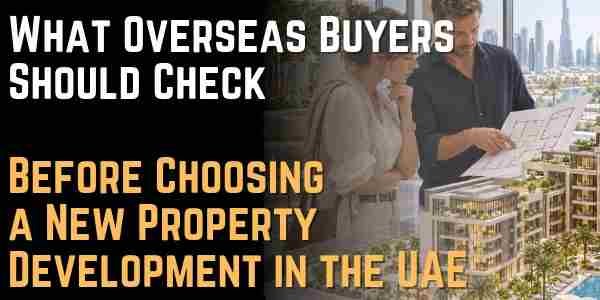
What Overseas Buyers Should Check Before Choosing a New Property Development in the UAE
The UAE continues to attract overseas buyers looking for a home, holiday residence or long-term investment. Dubai and Abu Dhabi offer a wide range of new apartment, townhouse and villa developments, at very different stages of construction and in communities that serve very different lifestyles.
For buyers considering a newly launched or off-plan property, the number of choices can make the market difficult to compare. Attractive renderings, celebrity-led launches and limited-time promotions are useful for understanding the concept, but they should only be the beginning of the research process.
A more reliable decision starts with the location, developer, construction stage, ownership structure and total cost of the property.
Compare the location before comparing prices
The UAE’s residential areas behave very differently from one another.
Downtown Dubai, Dubai Marina, Business Bay and Palm Jumeirah are established hubs with retail, dining, waterfront living and strong tourism demand. Dubai Hills Estate, Arabian Ranches and similar master-planned communities are popular with families because of their schools, parks and larger homes. Jumeirah Village Circle and other more affordable districts often appeal to investors seeking lower entry prices.
In Abu Dhabi, Saadiyat Island, Yas Island and Al Reem Island offer a quieter pace, cultural attractions and a growing choice of new projects.
Before concentrating on a single project, it is worth comparing several developments across different communities. This makes it easier to see whether a higher price comes from the location, the specification or simply the positioning of the project.
Buyers may also find it useful to look beyond the UAE to understand how pricing, ownership rules and rental performance compare elsewhere. For example, reviewing new property developments in Phuket alongside UAE projects gives a clearer sense of what each market offers for a similar budget. Thailand’s market is centred on resort-style living and holiday-home demand, and foreign buyers there face different ownership rules, such as condominium quotas, so the comparison helps show which approach better suits a buyer’s intended use.
Check the developer’s track record
With an off-plan purchase, the buyer relies heavily on the developer to deliver the finished project.
Previous projects provide useful evidence. Buyers can visit completed developments to examine construction quality, common areas, landscaping and maintenance. It is also worth checking whether earlier projects were handed over close to their announced dates and whether the finished result matches the original marketing material.
Buyers should also confirm that the developer and the project are properly registered with the relevant authority, such as the Dubai Land Department (DLD) and RERA in Dubai, or the equivalent regulator in Abu Dhabi. A developer with several completed projects gives buyers more to evaluate than a company launching its first scheme. This does not eliminate development risk, but it provides a stronger basis for comparison.
Understand the construction stage
The phrase “new project” can describe properties at very different stages.
Some developments are in early launch phases with only a sales gallery, while others have substantial construction progress. Some are close to handover, allowing buyers to see the building and its surroundings before deciding.
Early buyers often get a wider choice of layouts, floors and views, along with extended payment plans. Projects closer to completion offer more certainty about the final result, although fewer units may be available.
Buyers should check actual construction progress rather than relying only on the expected handover date in a brochure.
Compare usable space, not just the headline price
Starting prices are easy to compare, but they can be misleading.
The lowest advertised price may apply to a small number of units, a lower floor or a specific layout. Two apartments at similar prices may have noticeably different internal areas, balconies, views and finishing standards.
For villas and townhouses, both built-up area and plot size deserve attention. Buyers should compare price per square foot together with the quality of the location and specification. A cheaper unit is not necessarily better value if its space, position or build quality is significantly weaker.
Review the payment plan carefully
Off-plan projects in the UAE commonly offer staged payment plans, and some include post-handover instalments.
Schedules differ between projects. Some require a modest booking deposit followed by instalments tied to construction milestones, while others require larger payments early on. An overseas buyer should understand when each payment falls due and what happens if construction is delayed.
In Dubai, off-plan payments are generally expected to be paid into a regulated escrow account for the project. Buyers should confirm this before transferring funds, and should review the reservation form and sale and purchase agreement carefully. Those who need time to move money internationally should plan payment timing well in advance.
Understand the ownership structure
Foreign ownership rules in the UAE depend on the emirate and the area.
In Dubai and Abu Dhabi, foreign buyers can purchase freehold property only in designated areas. Buyers should confirm that the community and the specific unit carry the ownership type they expect, whether freehold or leasehold, and how the title will be registered.
Property above certain value thresholds may also support residency options, including the Golden Visa. Eligibility criteria change, so buyers should check current requirements with official sources before relying on this benefit. Independent legal advice is especially valuable when the buyer is purchasing remotely.
Calculate the total ownership cost
The purchase price is only part of the financial picture.
Buyers should allow for registration and transfer fees (in Dubai, the DLD fee is typically 4% of the property value), agency fees, and any mortgage-related costs. After purchase, annual service charges can vary widely between communities and can significantly affect net returns. Villa owners may also face costs for landscaping, pool maintenance and community management.
If the property will be rented out, short-term rental licensing, management commissions, cleaning, utilities, furnishing, repairs and vacancy periods should all be factored in. A realistic investment comparison should be based on net income rather than the headline yield used in marketing materials.
Check actual access to services and transport
Distances on a map can be deceptive.
A project may appear close to a metro station, beach or shopping centre but still require a long drive or walk because of major highways, construction, private land or limited pedestrian routes. Buyers planning to live in the property should test the real journey to schools, supermarkets, workplaces and main roads at peak traffic times.
For rental properties, practical accessibility strongly influences demand. Tenants and guests often value easy access to transport, the beach and daily services more than a small difference in amenities like the size of a pool or gym.
Compare several developments before reserving
Launch events and limited-availability messaging can create pressure to decide quickly.
A better approach is to compare several projects in the same area and price range first. Look at unit size, construction stage, developer history, payment terms, ownership structure, service charges and actual location. Once these factors sit side by side, it becomes much easier to see where a project genuinely offers value.
The UAE has a large and fast-moving new-build market. Buyers who take time to compare the fundamentals are in a much stronger position to choose a property that fits their intended use and budget.


About Author
